

When you doubt your worth, ordinary decisions can feel like tests: whether you have done enough, kept everyone happy or earned a break. You can begin with one situation that is making life harder, without demanding that you feel confident about your whole life.
Care, respect and support do not depend on a perfect record of achievement. You can take responsibility for a mistake, revise a commitment or ask for help while treating yourself as someone whose needs matter.
On this page
1. Make a harsh judgment more specific
Notice the difference between describing an event and judging your entire self. “I missed an appointment” gives you something to address. “I am useless” turns one event into a conclusion about everything you are.
The NHS guide to raising low self-esteem suggests examining negative beliefs, considering evidence and responding to yourself with the care you might offer a friend. You can try a fairer description without forcing an enthusiastic affirmation.
For example: “I forgot this appointment. I need to rearrange it and decide what reminder would help.” If your action affected someone else, consider an apology or practical repair. Taking responsibility does not require insulting yourself or pretending the effect did not matter.
2. Meet one need without making it a reward
Ask what would support the next part of your day. You may need a meal, rest, quiet, company or help arranging something important. Choose a response that fits your circumstances rather than a demanding routine that makes you feel further behind.
Difficulty caring for yourself can involve money, health, disability, work or caring responsibilities. It is not evidence that you are unattractive, selfish or choosing to be powerless. You may need practical assistance as well as a kinder way of speaking to yourself.
A small adjustment could be asking someone to take a whole task, postponing a non-essential chore or keeping an appointment you have repeatedly put off. Your needs can enter the plan even when someone else needs you too. There is no requirement to finish every responsibility before you may rest.

3. Keep commitments workable
Following through can matter to you, but a promise should be possible to keep. Before agreeing, check what the task asks of your time, resources and energy. “Let me check before I commit” gives you room to decide.
If circumstances change, revise the arrangement as clearly as you can. You might say, “I agreed to help this weekend, but I cannot do the full day. I can offer an hour, or we need another plan.” Offer an alternative only when you actually want and are able to provide it.
Missing a personal goal does not prove that your needs do not matter. Ask whether the goal was too large, poorly timed or missing support. You can change it, try a smaller version or stop. Dependability includes being honest about a limit rather than repeatedly making promises you cannot sustain.
4. Include yourself in relationship decisions
Consider an ordinary situation in which you tend to disappear from the conversation. Perhaps you always accept plans without checking your schedule, keep a concern private to avoid disapproval or do more than your share of a task.
When it feels safe, state one preference or request: “I would like to choose a time that works for both of us,” or “Can we divide the preparation as well as the clearing up?” Our guide to Making Room for Your Needs When You Want Connection offers more examples.
Mutual care leaves room for each person’s choices. You cannot require another person to return romantic feelings, and you do not need to earn affection through constant availability or achievement. A refusal can hurt without establishing that you are unworthy of connection.
5. Choose boundaries with safety in view
A request asks someone to cooperate. A boundary concerns what you will take part in or what you will do next. “Please stop making jokes about my appearance” is a request; “I will leave this conversation if those remarks continue” describes a possible limit.
Choose an action you can realistically and safely carry out. If a person controls your housing, money or access to support, a direct confrontation may have consequences that a simple script cannot address. Seek individual support from a trusted person or an appropriate local service if you fear retaliation.
You are not responsible for another person’s intimidation or mistreatment. If someone has hurt you, decisions about forgiveness, trust and contact can remain separate. After Someone Hurts You: Forgiveness, Boundaries and Your Pace explores those choices.
6. Seek support without another test to pass
You do not need to solve low confidence privately before talking with someone. Tell a trusted person what would help: listening, company while you arrange an appointment or help thinking through a particular decision.
If harsh self-judgment persists or caring for yourself has become difficult, consider speaking with a qualified healthcare professional. The NHS guide includes information about talking therapies. Seeking an assessment is a way to understand your needs, rather than proof that you have failed at self-care.
For today, choose a single response you can use: describe one mistake more fairly, meet a missed need or clarify an agreement. Notice whether it helps and what support is still missing. You can keep learning how to care for yourself while being a person who already deserves consideration.
Include yourself when two schedules collide
Suppose you always cancel a club meeting when another adult wants a lift. Keep both needs visible and decide whether an agreed pickup time, a different driver or an occasional lift is workable.
A sentence such as “I can help on Tuesday, and Thursday is already booked for me” gives the other person enough information to plan. Review the arrangement after a week if the requests keep coming.
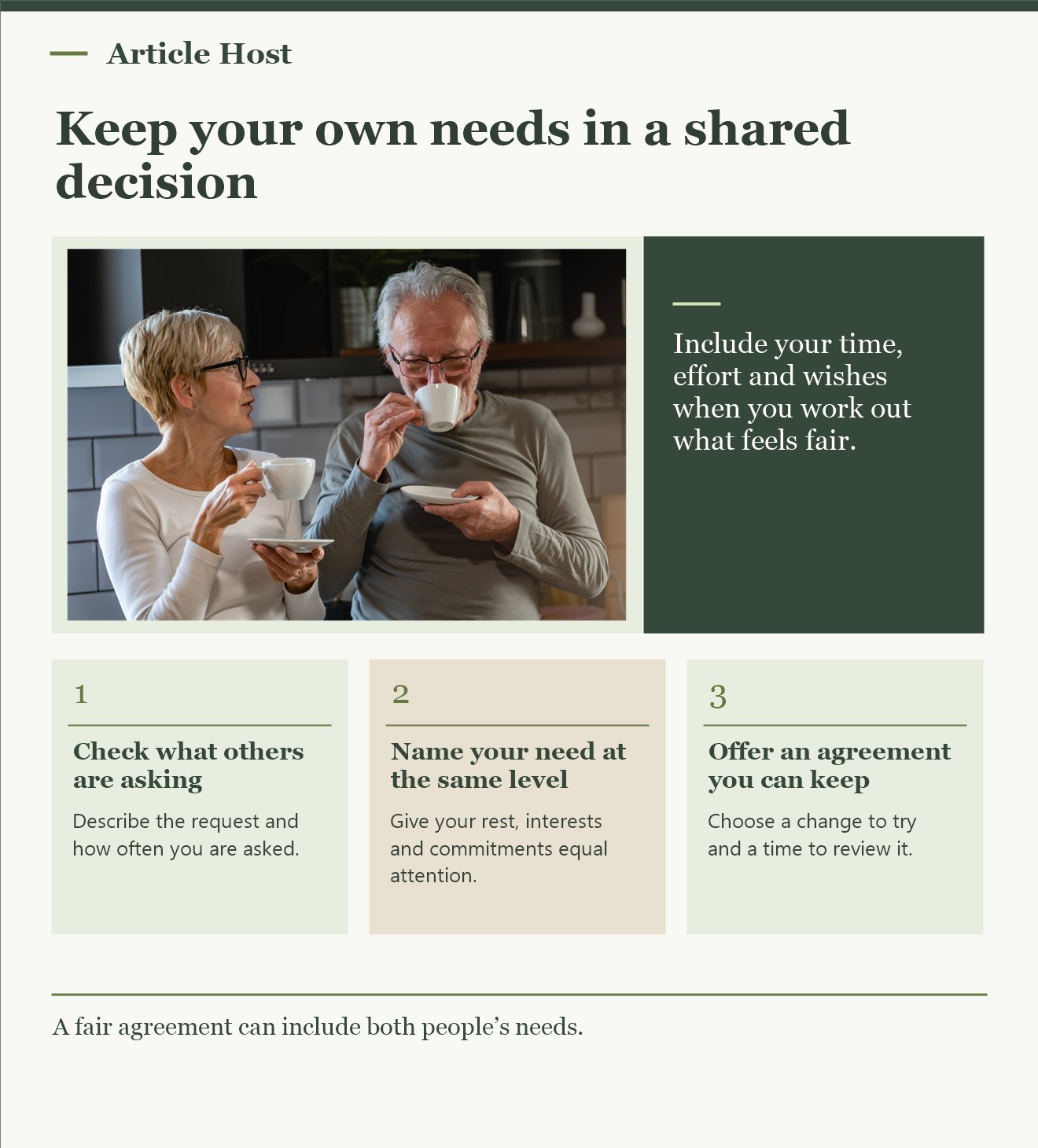
Read the infographic in text
Keep your own needs in a shared decision
Include your time, effort and wishes when you work out what feels fair.
- Check what others are asking Describe the request and how often you are asked.
- Name your need at the same level Give your rest, interests and commitments equal attention.
- Offer an agreement you can keep Choose a change to try and a time to review it.
A fair agreement can include both people’s needs.