

If you are considering Reiki, it helps to know what the appointment involves before you book. You may approach it as a spiritual practice, a quiet reflective experience or a way to take time for yourself. You can respect that meaning while asking clear questions about touch, cost, privacy and health claims.
Ask the practitioner to explain the session
Reiki commonly involves a practitioner holding their hands lightly on or above a fully clothed person. Arrangements vary: you might sit in a chair or lie on a treatment table. Ask about the setting, appointment length and whether the session includes physical contact before agreeing to it.
Some practitioners offer sessions remotely. Ask exactly what you will be paying for and what will happen during the appointment. A spiritual explanation of distance work should not be presented as a guaranteed health result.

Agree on comfort and consent
Say whether you want hands-off work, whether any areas are uncomfortable and whether you need a different position. You can ask to pause, change the arrangement or stop. Agreeing to a session does not remove your right to change your mind about touch.
You do not need to share private experiences to prove that you are open to the practice. Ask how personal information is handled and whether anyone else will be present.
Keep spiritual beliefs and medical claims distinct
Practitioners may describe Reiki using ideas about life energy or balance. You can find those ideas meaningful without treating them as a diagnosis of why you feel ill or tired.
The National Center for Complementary and Integrative Health’s Reiki overview reports that research has not established clear effectiveness for a health condition, or scientific evidence for the proposed energy field. Claims that Reiki will strengthen immunity, repair digestion or speed recovery therefore need more than a practitioner’s assurance.
If you have symptoms or a medical concern, discuss them with a qualified healthcare professional. Do not delay an assessment or alter prescribed care because someone says an energy blockage explains the problem.
Know the practical terms before paying
- What is the full price, and is a package optional?
- What is the cancellation policy?
- Will there be touch, scent, music or other elements you may want to decline?
- What training does the practitioner actually hold, and what does it qualify them to do?
- Can you stop without pressure to buy another appointment?
A training certificate in a spiritual practice does not, by itself, establish a medical qualification. Be cautious about pressure to purchase repeated sessions to prevent something bad from happening.
Leave room for your own response
You might enjoy the quiet, feel relaxed, notice little or decide the experience does not suit you. None of those responses proves that you have failed or that you need to spend more money. Judge the appointment partly by whether your choices were respected and the claims made to you were clear and proportionate.
Related reading: Emotions and Energy: Notice Your Needs and Find Practical Support.
Read the infographic in text
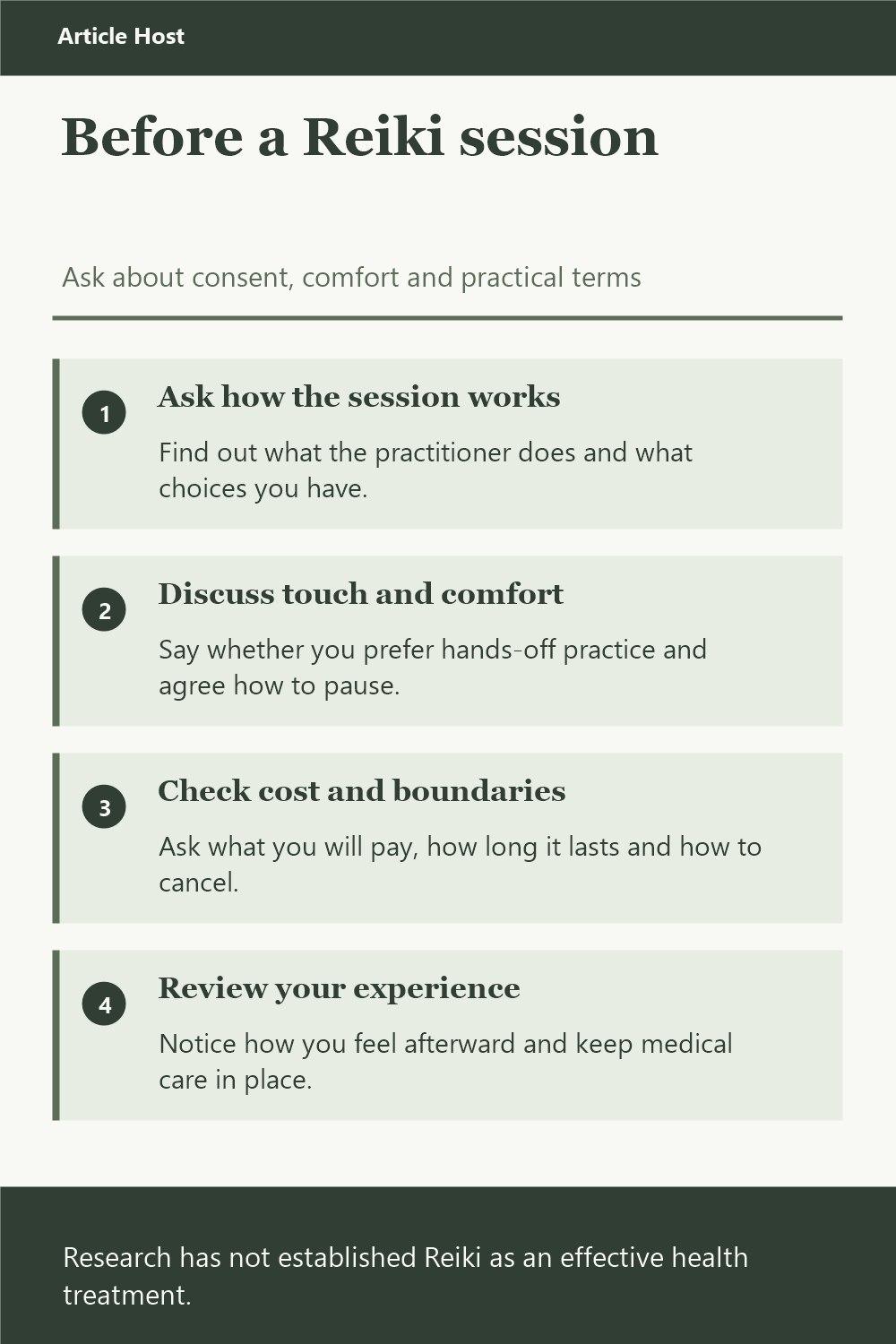
Before a Reiki session
Ask about consent, comfort and practical terms
- Ask how the session works Find out what the practitioner does and what choices you have.
- Discuss touch and comfort Say whether you prefer hands-off practice and agree how to pause.
- Check cost and boundaries Ask what you will pay, how long it lasts and how to cancel.
- Review your experience Notice how you feel afterward and keep medical care in place.
Research has not established Reiki as an effective health treatment.