

Self-esteem is the way you view and value yourself. When that view becomes harsh, an ordinary mistake or another person’s success can feel like a verdict on your whole life. A fairer view leaves room for difficulties, strengths and things you are still learning.
You do not have to feel impressive, cheerful or certain before treating yourself with respect. Start with one of the steps below; there is no need to turn all six into another standard to meet.
On this page
1. Make a harsh judgement more specific
Notice the sentence you are using about yourself. “I cannot do anything right” is a much bigger claim than “I missed a deadline.” Ask what happened, what evidence you have and what you would need next.
A balanced response might be: “I missed this deadline. I can tell the person, ask what is still possible and change my reminder system.” This acknowledges the problem without turning it into your identity. You do not have to replace a painful thought with praise you cannot believe.
The NHS guide to low self-esteem recommends examining negative beliefs and considering evidence that challenges them. If writing helps, try two short notes: the judgement, then a more accurate account. Stop if the exercise becomes another way to criticise yourself.

2. Choose a manageable commitment
Pick something small enough to fit your current energy and circumstances. You might ask one question in a meeting, practise a skill for a few minutes or arrange an appointment you have been putting off.
Decide what counts as enough before starting: “Read one page,” rather than “Become a well-read person.” Afterwards, notice what helped or got in the way. If the task was too large, change the size, timing or support you need.
Completing a task can give you information about what you can do. Missing it does not take away your worth. You are allowed to rest, need help or revise a plan, including when illness, disability, caring duties or money limits what is possible.
3. Put comparison in context
A comparison rarely includes the whole picture. You may see another person’s finished project without seeing their time, resources, help or setbacks. Ask whether the comparison gives you a useful idea or simply leaves you feeling smaller.
If it offers something useful, make it specific: “I would like to learn how they organise that task.” If it repeatedly hurts, consider muting an account, changing the topic or taking a break from checking updates. You do not need to prove that the other person is doing something wrong.
Comparing yourself with your past can also be painful after a loss or a change in health. Instead, ask: “What would make today more workable with the circumstances I have now?” Progress does not always look like doing more.
4. Repair a mistake without attacking yourself
Self-respect and responsibility can go together. If you have hurt someone, focus on the action: acknowledge what you did, listen to the impact and offer a realistic repair. The other person can decide whether to accept an apology.
For example: “I interrupted you twice. I am sorry. I will let you finish before I respond.” That gives you something to practise. “I am a terrible person” does not tell either of you what will change.
For a practical setback, separate what you could influence from what you could not. Make one adjustment you can use next time. Repeatedly replaying the incident is not a requirement for taking it seriously.
5. Practise kindness with boundaries
Kindness does not require insincere compliments, endless availability or accepting disrespect. Offer help because you have the capacity and choose to, rather than using it as an entrance fee for belonging.
Try a clear limit where it is safe: “I cannot take that on this week,” or “I can help for half an hour.” You can care about someone and still decline a request. A disappointed response does not automatically mean the boundary was wrong.
If there are insults, threats or control, improving your self-esteem is not the condition you must meet to deserve safety. The person causing harm is responsible for their behaviour. Read about recognising verbal abuse and finding support if that fits your situation.
6. Notice what matters beyond achievement
Look for qualities you want to practise, such as curiosity, fairness, patience or honesty. Keep the example ordinary: asking for clarification, admitting you do not know something or making time to listen.
You might jot down one moment when you acted in line with a value, or one thing you enjoyed without needing to do it well. This is an invitation to notice more of your life, not a daily scorecard.
There may be days when you cannot find a positive example. You still deserve food, rest, connection and care. Your appearance, relationship status, productivity and usefulness to others are not tests you have to pass before receiving those things.
When to seek more support
If harsh self-judgements persist, become more intense or interfere with daily life, talk with a healthcare or mental-health professional. You can describe what you notice without diagnosing yourself: “I keep putting myself down, and it is affecting what I can do.” The NHS guide above describes talking therapies as an option for low self-esteem.
A trusted person may help you think through a next step or come with you to an appointment. If the thoughts are becoming especially painful, this guide to responding to thoughts of self-hatred includes immediate support options when safety is a concern.
For now, choose one fair response or one practical action you can manage. You can build a different relationship with yourself while still having difficult days.
Review your day using three concrete observations
After a difficult shift, write one thing you handled, one thing that needs attention and one factor you could not control. If you had to cover a full desk with half the usual staff, put that constraint in the record alongside your own choices.
Where something needs repair, give it a small next step. Return later and see how different the record looks from the original thought that you failed at everything.
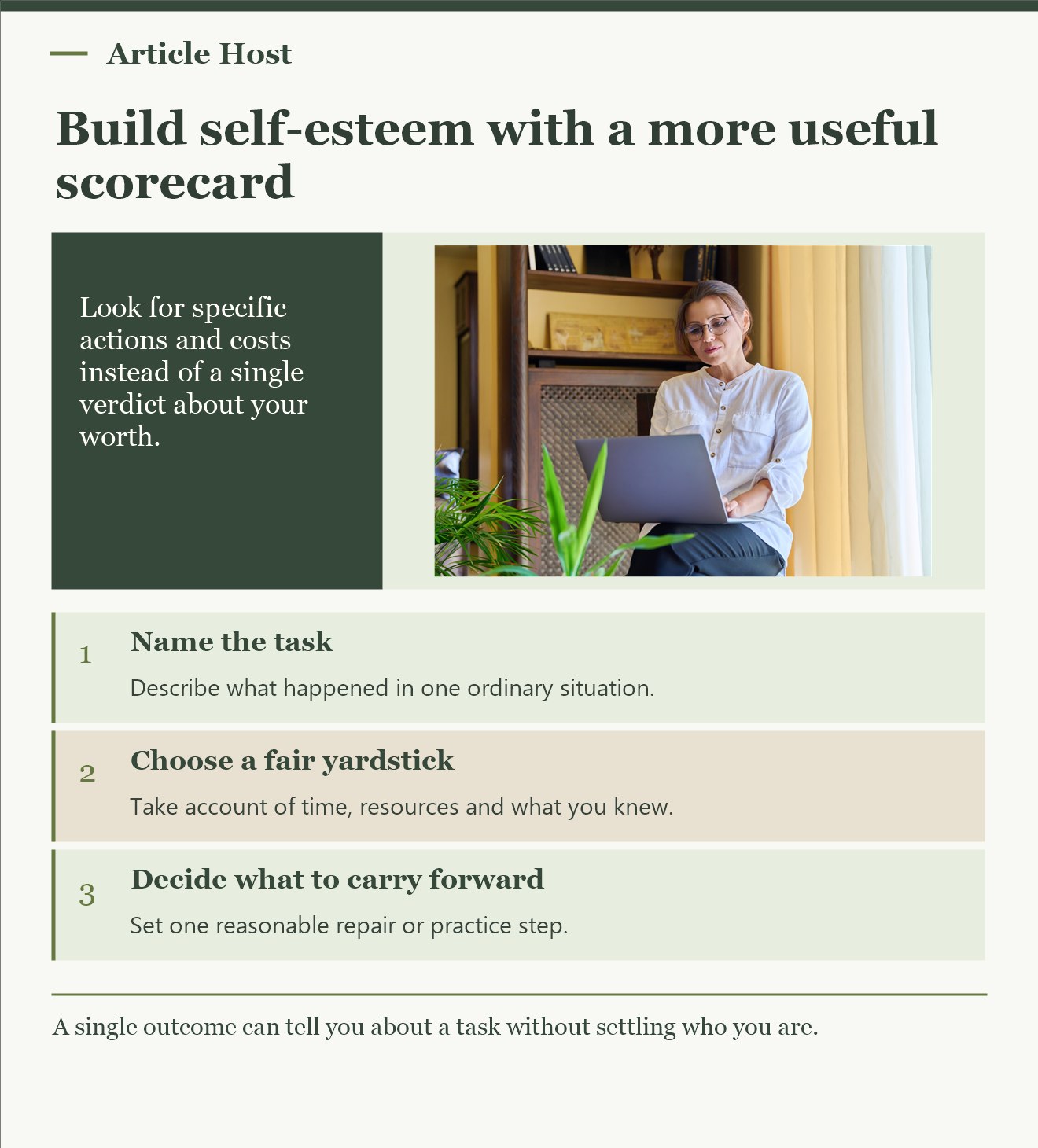
Read the infographic in text
Build self-esteem with a more useful scorecard
Look for specific actions and costs instead of a single verdict about your worth.
- Name the task Describe what happened in one ordinary situation.
- Choose a fair yardstick Take account of time, resources and what you knew.
- Decide what to carry forward Set one reasonable repair or practice step.
A single outcome can tell you about a task without settling who you are.