

Loving yourself does not have to mean feeling confident, admiring everything about yourself or staying positive through a difficult day. It can begin with treating your needs and limits as worth considering, even when your feelings about yourself are mixed.
You are allowed care and connection while you work through self-doubt. You do not have to achieve perfect self-love before someone else can love you or before you can care about them.
On this page
Notice how you speak to yourself
Pay attention to the words you use after a disappointment. “I missed the deadline” describes an event. “I am useless” turns that event into a verdict on your whole self.
You do not need to replace every painful thought with a glowing affirmation. Try a statement that is fair and believable: “I am disappointed. I can check what happened and decide what to do next.” Leave room for the feeling without making it the only information that counts.
If an exercise involving a mirror, journal or affirmation makes you feel worse, you can stop or choose something different. Caring for yourself is not a performance with a required script.
Choose one practical act of care
Ask what would make the next part of today more manageable. The answer might be a meal, a break, a necessary appointment, a more comfortable place to sit or help with a task.
- Name one need you have been putting aside.
- Choose a step that fits the time, money and energy available.
- Reduce the step if it is too much to start.
This does not require an expensive routine or a complete lifestyle change. Reading a few pages may be welcome; so may asking someone to share a responsibility so you can rest. Our ideas for making more room for personal care offer another place to reflect.
Make room for limits
A boundary describes what you can offer or what you will do. You might say, “I can help for half an hour,” or “I cannot take that on this week.” You do not need to offer an elaborate defence of every preference.
Limits can still feel uncomfortable. Another person may be disappointed, and you may need to discuss practical alternatives. Their disappointment does not automatically mean your decision was unkind.
If expressing a limit could lead to threats, control or harm, prioritise safety rather than rehearsing a firmer speech. Consider support from someone you trust or an appropriate local service, using a setting or device you believe is safer.
Respond to mistakes fairly
Self-kindness can include responsibility. If you hurt someone, name what you did, listen to the effect and consider a repair you can actually make. You do not have to pretend the mistake did not matter.
At the same time, repeated self-punishment is not a practical repair. Ask what needs changing: a habit, an expectation, missing information or a commitment that was unrealistic. Choose a next action rather than demanding that you never make another mistake.
You can also reconsider whether a past event was yours to take responsibility for. Being mistreated is not evidence that you failed to love yourself enough.

Let support be part of care
You do not have to manage every difficulty alone to prove that you value yourself. Support may come from a friend, a community connection, practical assistance or a qualified professional when distress is persistent or hard to manage.
Ask for something specific when you can: company at an appointment, help sorting a task or a conversation where you would prefer listening to advice. Other people may have limits too; a declined request does not decide your worth.
For today, choose one fairer sentence and one manageable act of care. You can practise those actions while confidence is still developing.
Rewrite the thought that follows a scheduling mistake
If you double-book yourself and think, “I ruin everything,” try, “I made a scheduling error and need to correct it.” Contact the people affected early and give yourself time to reset. Notice if the fairer wording helps you make the next call.
Later, put both commitments in the same calendar or choose a check before agreeing to an appointment. You can repair the practical issue and avoid turning it into a judgment about your whole character.
Read the infographic in text
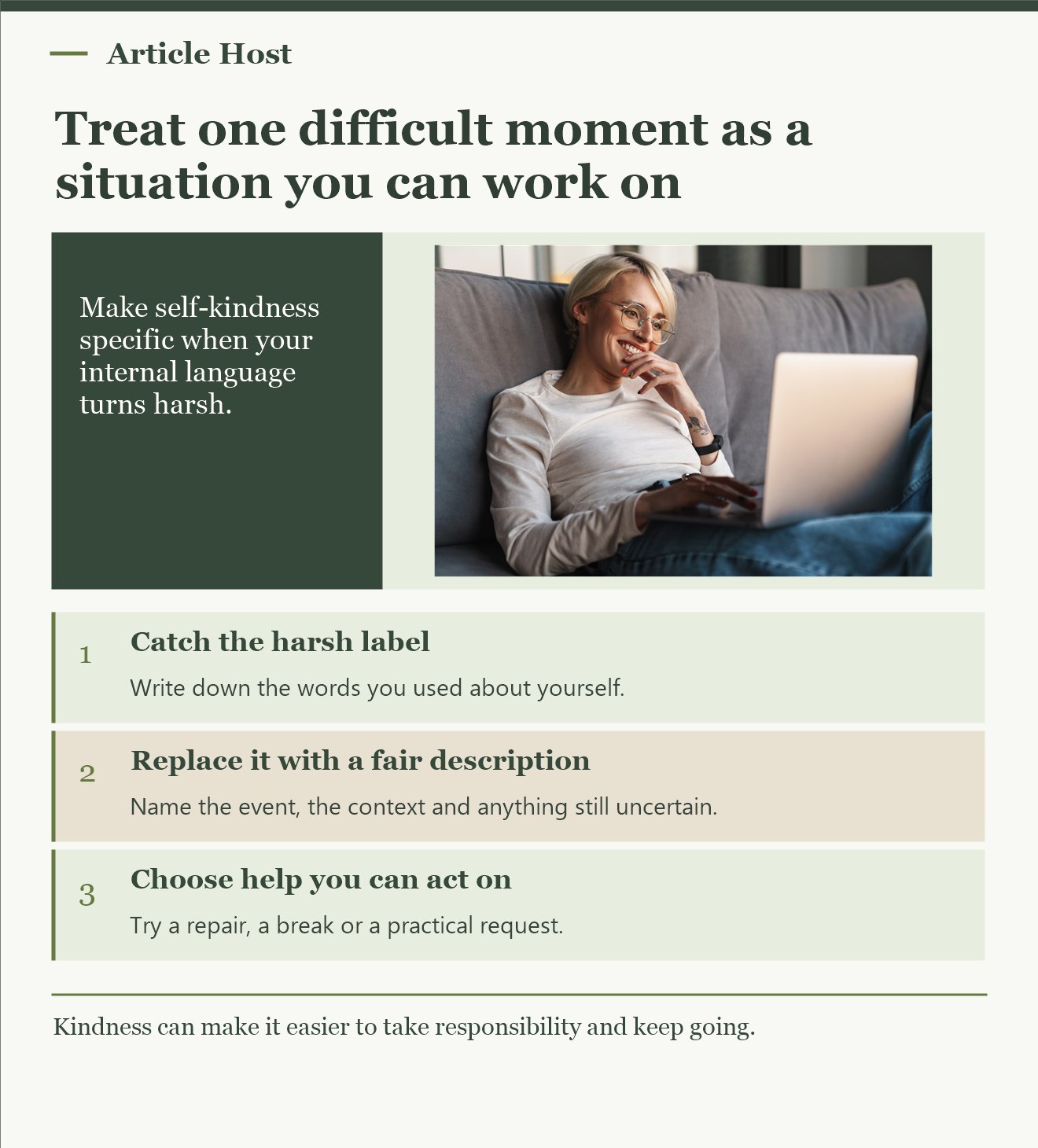
Treat one difficult moment as a situation you can work on
Make self-kindness specific when your internal language turns harsh.
- Catch the harsh label Write down the words you used about yourself.
- Replace it with a fair description Name the event, the context and anything still uncertain.
- Choose help you can act on Try a repair, a break or a practical request.
Kindness can make it easier to take responsibility and keep going.