

One warm conversation followed by silence can leave you wondering where you stand. “Mixed signals” is a useful description of your uncertainty, but it does not tell you why another person is acting that way. A late reply, a liked photograph or a cancelled plan cannot establish their intentions on its own.
Look at the actual pattern, ask about what matters and decide what contact works for you. You do not have to prove that someone is deliberately using you before choosing a different arrangement.
On this page
Describe what is unclear
Separate what happened from the explanation you are giving it. “They suggested dinner twice without choosing a day” is an observation. “They are keeping me as a backup” is a conclusion that may go beyond what you know.
A specific description also helps you notice what you need. Is the difficulty an unpredictable schedule, uncertainty about exclusivity or an expectation that you answer messages immediately? These are different issues and may need different conversations.
Allow room for ordinary differences. Someone may use their phone infrequently, have changing work hours or enjoy a conversation without wanting to date. Those possibilities do not require you to accept contact that leaves you unhappy. They simply help you avoid treating every ambiguous action as evidence of a hidden strategy.

Ask a question you need answered
Choose a question that relates to your decision. You might ask, “Would you like to make a plan for Saturday?” or “Are you looking for a relationship, casual dating or something else?” You can be direct without asking for a promise about the distant future.
State your own position too. “I am interested in dating, but casual sex would not suit me” gives the other person information they can respond to. You do not have to agree to one arrangement in the hope that it will turn into another.
If someone has clearly said they do not want a relationship, do not reinterpret affection or sexual interest as a secret commitment. They may enjoy some kinds of closeness while wanting something different from you. Consent to one interaction also does not create agreement to another.
When a reply remains vague, you can ask once for the missing detail. Repeatedly seeking a different answer may leave you with less clarity rather than more.
Compare words with follow-through
Notice whether an agreement becomes something you can use. If a plan changes, do they tell you and suggest another time? If you discuss a concern, do they acknowledge it and respond in a way that addresses the problem?
One disrupted week may be different from months of promises without plans. Consider the circumstances and the effect on you. You are allowed to decide that even an understandable limitation makes the connection unsuitable at present.
Social-media activity rarely answers the whole question. Following, unfollowing or liking a post does not confirm love, manipulation or readiness. Avoid using read receipts, response-time calculations or jealousy tests as a substitute for an actual agreement.
Some behaviour deserves attention regardless of motive. Insults, pressure for sex, sharing private messages without agreement or demands for constant access are concerns in their own right. You do not need a personality label to take them seriously.
Choose a limit you can keep
A practical limit describes your availability and choices. “I cannot keep the evening open without a confirmed plan” is clearer than trying to make someone miss you. “I do not answer personal messages during work” explains a boundary without turning delay into a tactic.
Make room for your own preferences. Our article on keeping your needs in view when you want connection explores how to notice what you are agreeing to and what you actually want.
A limit does not guarantee that someone will change. It helps you decide what you will do if the current pattern continues. Choose something realistic, and avoid announcing a consequence mainly to provoke reassurance.
Decide what happens next
After the conversation, consider the information available now. You could continue with a clear plan, reduce contact, decline a particular arrangement or stop dating. You can make that choice without deciding that the other person is entirely good or bad.
If contact involves threats, monitoring or repeated unwanted approaches, seek appropriate support and consider safety before confronting the person. A trusted friend or specialist service may help you think through practical options.
Clarity sometimes means recognising that no workable agreement is available. You do not have to keep decoding a connection that does not meet your needs.
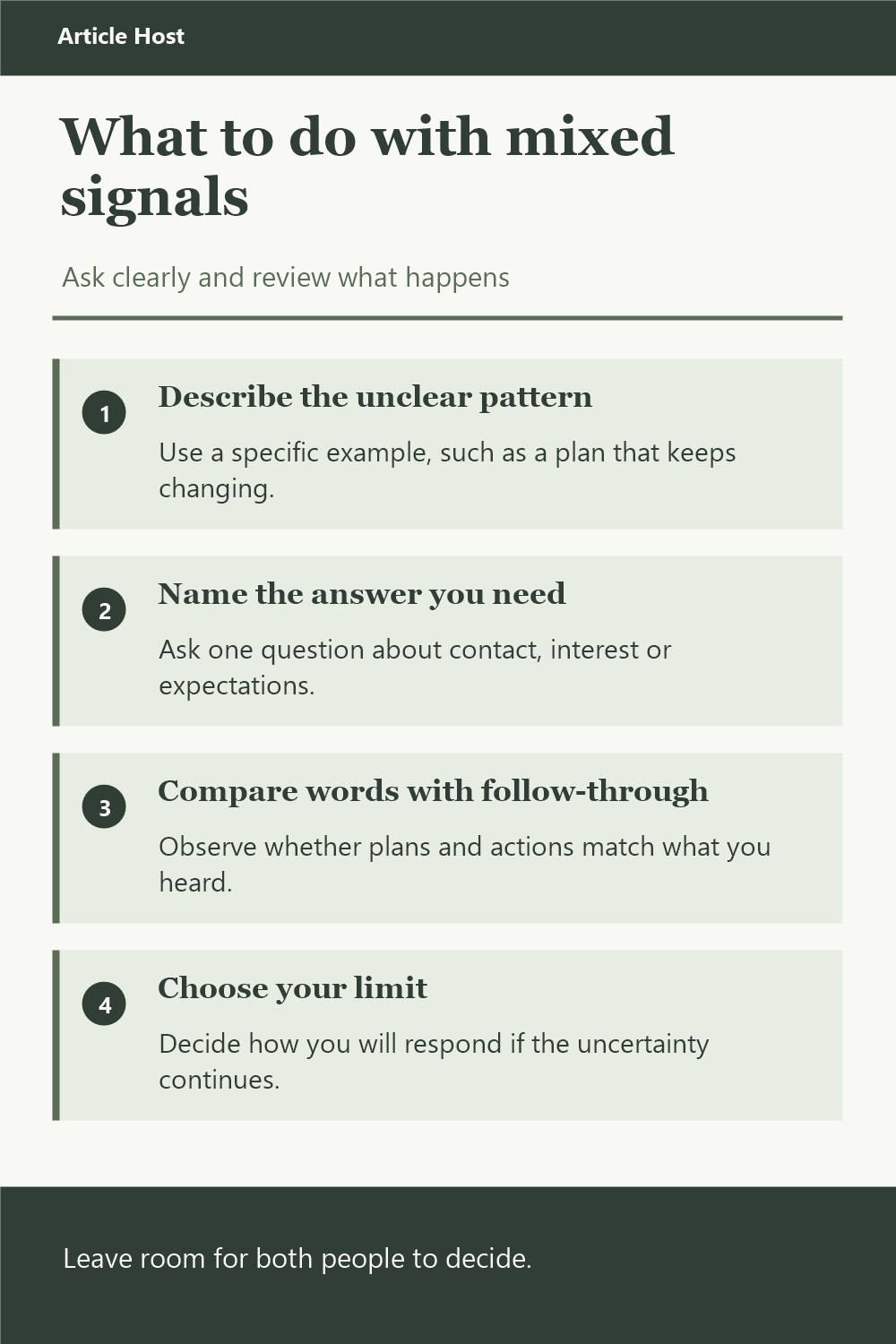
Read the infographic in text
What to do with mixed signals
Ask clearly and review what happens
- Describe the unclear pattern Use a specific example, such as a plan that keeps changing.
- Name the answer you need Ask one question about contact, interest or expectations.
- Compare words with follow-through Observe whether plans and actions match what you heard.
- Choose your limit Decide how you will respond if the uncertainty continues.
Leave room for both people to decide.