

Talking about a stressful experience can offer company, a different perspective or help with a decision. You might want someone to listen before you think about solutions. That is a reasonable need to express.
There is no rule that feelings must be released like pressure from a container, or that you may discuss a problem only twice. A useful conversation depends on what you need, what the listener can offer and whether the exchange is helping.
On this page
Ask whether the person has room to listen
Begin with a question someone can answer honestly: “I have had a difficult day. Is now a reasonable time to talk?” If time matters, you can add, “Could we talk for a few minutes before you leave?”
A person may care about you and still be tired, occupied or unsure how to help. If they cannot talk now, consider another time, another trusted person or a support service. Their availability at one moment does not establish how much your concern matters.
The NHS guide to talking about mental health suggests choosing someone you trust and explaining what support you would like. You do not have to share everything in a first conversation.

Say what kind of support would help
Try naming the purpose of the conversation. The same story can lead to very different responses depending on whether you want company, information or practical assistance.
- Listening: “I want to describe what happened. Please hear me out before offering ideas.”
- Thinking together: “Could you help me consider a few options?”
- Practical help: “Could you help me make this call or deal with one task?”
You can change your mind as the conversation develops. If advice is not useful, say so respectfully: “I appreciate the suggestion. I would like to stay with what I am feeling for a moment.” The listener can also explain what they can realistically offer.
Keep the conversation respectful and private
Speaking honestly about being upset does not require insulting everyone involved, revealing another person’s private information or sending messages you may regret. Focus on the experience and what you need from the conversation.
At work, consider the setting and the listener’s role. A colleague may be able to listen briefly, while an ongoing workload problem may need a discussion with the person who can change the arrangement. Avoid assuming that an informal conversation has the privacy protections of professional support.
If you are listening, you can acknowledge the difficulty without promising a solution or agreeing with every conclusion. The CDC’s guidance on supportive conversations offers ways to listen and show concern. You can ask what kind of help would be welcome.
Notice when talking needs a different direction
You may need to revisit something important more than once. Repetition is not automatically a failure to move on. At the same time, consider whether the conversation is leaving you understood, helping you decide something or becoming more upsetting without giving either person room to pause.
If the discussion is going in circles, try a different question: “What part is still unresolved?”, “Do I need information I do not have?” or “Would practical help be more useful today?” You can also stop for now and return later.
There is no need to force a positive ending or find a lesson in what happened. A conversation can end with a clearer request, an agreement to check in or a simple acknowledgement that things are difficult.
Make space for further support
A friend does not have to become your only source of help. If distress is persistent, affects everyday life or needs more support than an informal conversation can provide, consider speaking with a qualified professional or an appropriate local service.
You can ask about the cost, privacy, availability and kind of support before deciding what to share. If the issue involves abuse or threats, seek specialist help that takes safety into account rather than relying only on advice to talk it out.
After a conversation, choose what you need next: company, rest, another conversation or one manageable action. You do not have to feel better immediately to have been worth listening to.
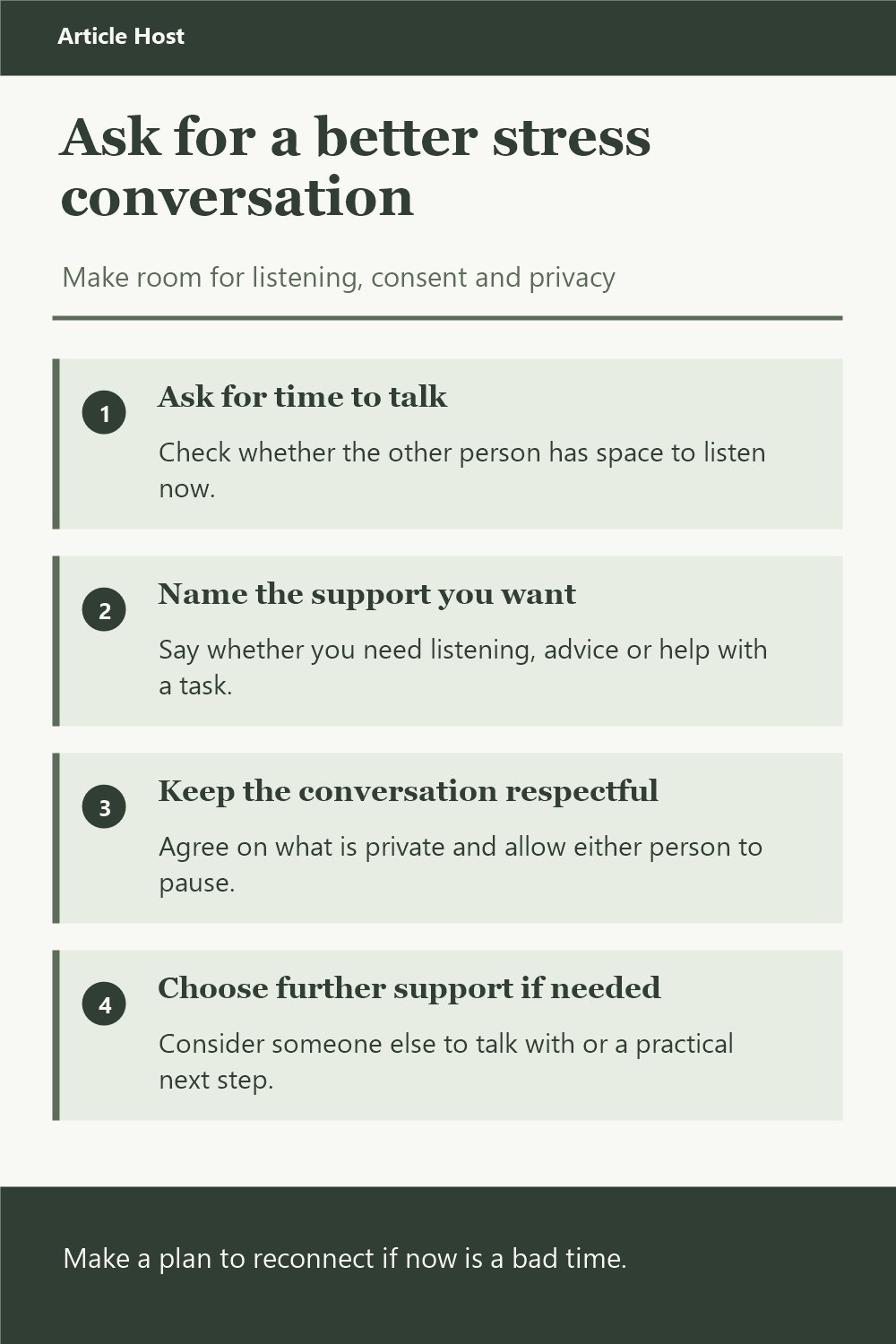
Read the infographic in text
Ask for a better stress conversation
Make room for listening, consent and privacy
- Ask for time to talk Check whether the other person has space to listen now.
- Name the support you want Say whether you need listening, advice or help with a task.
- Keep the conversation respectful Agree on what is private and allow either person to pause.
- Choose further support if needed Consider someone else to talk with or a practical next step.
Make a plan to reconnect if now is a bad time.