
As I put together last week’s posts on using affirmations to reach your goals, I got obsessed with figuring out how the new thought concept of the Law of Attraction works. It seems so magical to me and so mysterious.
Some people understand the law of attraction as a spiritual belief. You can explore that belief and use its practices to clarify a goal. A thought cannot guarantee a particular outcome, and an outcome has many possible causes.
In this post I’ll share what I understand as the Law of Attraction basics. I’m still new to it all, though, so I’m certainly not claiming that I have the answers to all of the questions you may have. As always, I’ll share what I’m learning as I learn it. I know many of you are as interested in exploring these concepts as I’ve become!
People approach the subject with different beliefs. If you are interested in trying a practice, begin with a goal you can describe and leave room to change your mind about what helps.
With all that said, here are some of the highlights from what I’ve learned so far about the Law of Attraction. I look forward to sharing more information, along with my success stories, with you in the future!
On this page
The Foundation
 The Law of Vibration forms the basic foundation of the Law of Attraction, so that’s where I’ll start. According to The Law of Vibration, everything in the universe, whether it’s visible or not, can be quantified as an energetic pattern or a frequency. Everything in the universe is made of subatomic particles that constantly vibrate. This includes all physical matter that you can touch as well as intangible things like our feelings and thoughts.
Honesty, I’ve been trying to understand this for a while now. Despite that, I’ve concluded that the Law of Vibration is something I’ll need to resolve to believe in despite the fact that I can’t perceive it with my five senses. There are all sorts of things that I believe although I can’t actually perceive. We live in a universe with more than billions of galaxies that I can’t see. The earth is round, and I can’t readily perceive that, So I’m open to the Law of Attraction. You’ll have to decide yourself where you stand!
People sometimes use “frequency” to describe a mood or sense of alignment. In physics it has a different, measurable meaning. The spiritual use of the word does not establish that a person can make outside events happen through thought.
Like Attracts Like
The phrase “like attracts like” is one way people summarise the belief. In ordinary life, what you pay attention to can affect what you notice and what you choose to do. You can watch for those effects without interpreting every outcome as a response to your thoughts.
At this stage in my learning, I still find discussing “raising your vibration” to be a difficult concept to grapple with. I’m just being honest here! So I myself like to think about the Law of Attraction in simpler terms—the idea that you will get more of what it is that you’re focused on. Law of Attraction adherents talk about this aspect a lot. Once I explored the science behind this, and saw it working in its completely mystical way, I felt my only option was to believe in it!
Picturing an outcome can help you describe what you want. If the picture matters, ask which action would make progress more likely under the circumstances you are in.
What Can You Attract?
People use the belief to reflect on relationships, money, work or personal projects. The practical options depend on your resources and situation. Other people have their own wishes and decisions, and serious choices about money or health call for reliable information.
Law Of Attraction Misconceptions
I can’t get into all of the misunderstandings surrounding the Law of Attraction in one blog post. And honestly, there are some questions that I haven’t found a good answer to yet! I thought I’d highlight a few of the more common misunderstandings some doubters have in case you have one of them, too.
A vision board or statement of intention can help clarify what matters. Next, consider one opportunity, one obstacle and a specific action you can try this week.
Personal belief and scientific explanations answer different questions. Claims about attracting external events through thoughts would need evidence that can separate the effects of thought from action, circumstance and chance.
Doubt, anger, grief and other difficult feelings are part of ordinary life. You can make a thoughtful choice while having those feelings. Experiencing them gives no reason to blame yourself for an unwanted event.
The Conscious, the Subconscious, and the Unconscious Mind
Trying to notice a recurring thought can give you information about a habit or fear. Try writing down what happens around it and what you do next. A simple observation may be more helpful than attempting to control every thought throughout the day.
People can do familiar things with little deliberate attention. You can use a useful cue, such as a note beside your keys, to make an intentional action easier when your routine takes over.
Essentially, we need to learn to be purposeful with our conscious beliefs and thoughts. You can also do things to form and influence subconscious beliefs. You could repeat new beliefs right before bed or immediately after waking up. You could listen to a guided meditation to reinforce the beliefs you want to hold in your subconscious mind. You could use affirmations. The things we place in our subconscious minds and encourage with emotion and repetition will certainly become reality someday.
This is one of the things I’m honing right now, so I’m not able to say much more at the moment. Suffice it to say that I’ve experienced much success using affirmations to form and encourage new subconscious beliefs. Visualization and vision boards can also be helpful.

Essentials About the Law Of Attraction

These are ways to give reflection some structure. Try the ones that fit your goals, and review what actually changes.
- Belief. Name a goal you think is worth exploring and what a realistic sign of progress would look like.
- Imagination. Picture a specific result. The author recalls, “I honestly felt kind of delusional when I first started doing this.” A picture of your preferred future can also help you name which part of it you want to test first.
- Emotion. Notice what the goal brings up and whether the feeling gives you useful information about what to do next.
- Gratitude. Name something you appreciate and something you would like to change. The author writes, “It’s hard to feel true gratitude for what you already have while you genuinely desire more. This is something I’m personally working on right now!”
- Flexibility. Identify something outside your control and give the plan room to change when you learn new information.
- Repetition. Repeat an action that you can reasonably do and keep a brief record of what changed.
- Patience. Choose a date for a review, and decide then whether to keep, adjust or stop the plan.
The author also describes sharing a podcast episode about habits that can get in the way of a goal. As you reflect, look for constraints in your schedule or environment as well as habits you could change.
Try a wish, an obstacle and an if-then plan
Suppose you wish for a job with more predictable hours. Picture how that would change an ordinary Wednesday. Name a likely obstacle, such as doing paperwork at the time you usually look for openings. Write a plan: “If it is Tuesday at 7 and I am at home, I’ll check two organisations that list their hours.”
Check the result after two weeks. Did you find a suitable opening or get better information about schedules? Mental contrasting and if-then planning have been studied as tools for pursuing goals. The practice and the result are separate things you can observe.
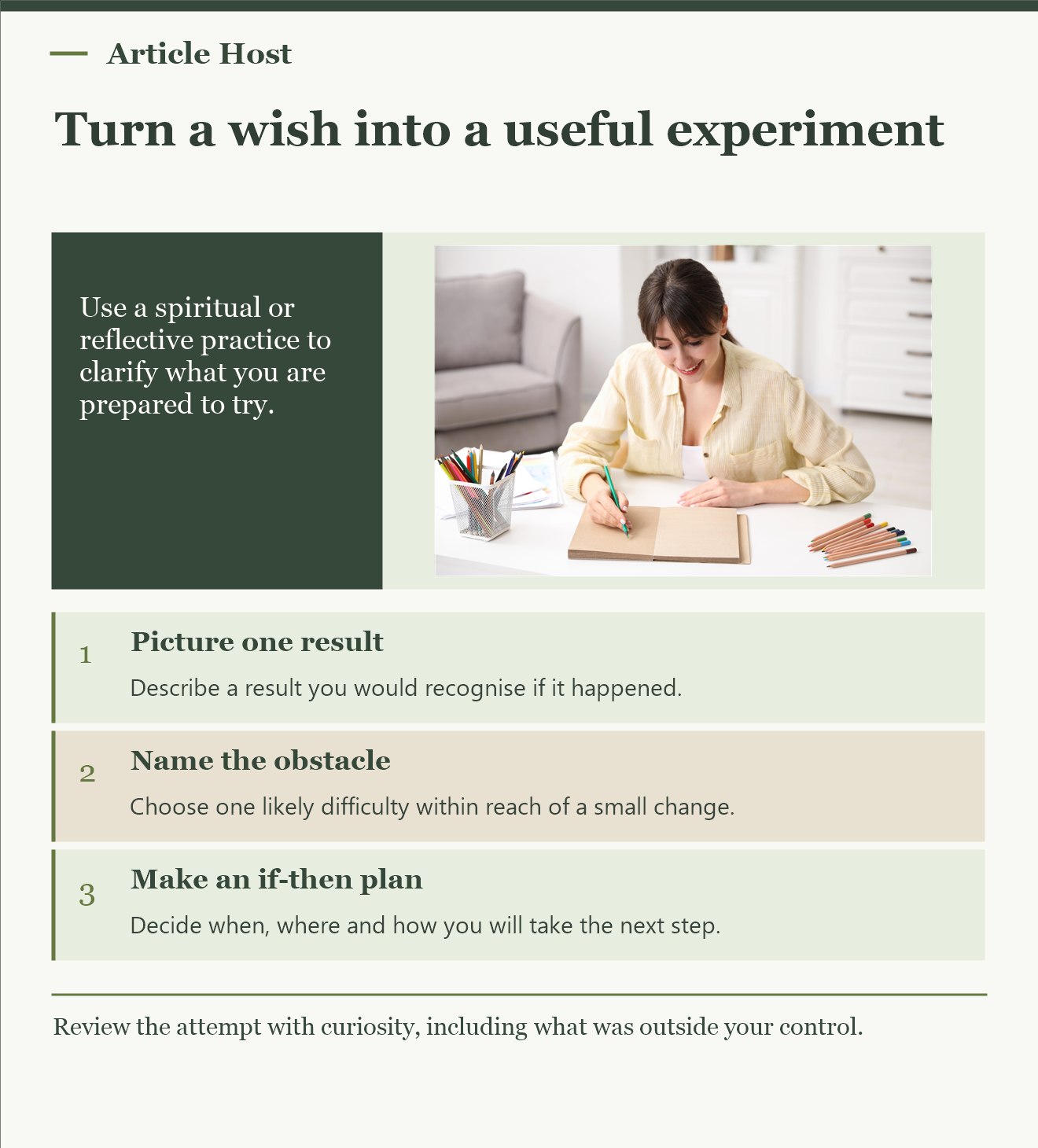
Read the infographic in text
Turn a wish into a useful experiment
Use a spiritual or reflective practice to clarify what you are prepared to try.
- Picture one result Describe a result you would recognise if it happened.
- Name the obstacle Choose one likely difficulty within reach of a small change.
- Make an if-then plan Decide when, where and how you will take the next step.
Review the attempt with curiosity, including what was outside your control.