

You might use the phrase spiritual awakening for a change in what feels meaningful: questions about your values, a renewed interest in faith or a sense that familiar priorities no longer fit.
That description can matter to you without proving a worldwide shift, a hidden political truth or a particular destiny. You can explore the experience at your own pace while keeping ordinary needs, reliable information and your freedom to question.
On this page
Describe what is changing for you
Write down what you have actually noticed. Are you drawn to a different practice, reconsidering a commitment or wanting more time for reflection? Separate that observation from an explanation you have heard elsewhere.
You do not have to name the experience immediately. Your understanding can change as you read, talk with people you trust and notice how a practice affects your everyday life.
Spiritual language can offer meaning, but it does not establish that a prediction is true or that every coincidence is an instruction. Leave room for more than one interpretation.
Choose affirmations that leave room for choice
An affirmation can be a reminder of how you want to respond. It need not claim that you are completely certain, always protected or guaranteed a particular result. Adapt these fourteen statements to your own beliefs:
- I can explore what matters to me without rushing.
- I can notice a feeling before deciding what it means.
- I am allowed to ask questions.
- I can keep commitments that support my wellbeing.
- I can change my mind when I learn something new.
- My needs matter alongside the needs of others.
- I can enjoy a spiritual practice and keep practical support.
- I do not need to turn every difficulty into a lesson.
- I can choose one action that reflects my values.
- I can respect another person’s different belief.
- I can keep boundaries in a spiritual community.
- I can seek help when something feels overwhelming.
- I can leave a claim unresolved when evidence is missing.
- I can make room for meaning without promising an outcome.

Pair one statement with an ordinary action
Choose the line that feels useful today. If you choose to ask questions, write down one thing you want to understand. If you choose boundaries, decide what time, money or personal information you are comfortable sharing.
A prayer, quiet reflection or a journal entry can fit alongside practical care. You do not need to intensify a practice, buy a programme or make a major decision to show that your experience is real to you.
Notice what follows. Does the practice help you approach daily life with more clarity, or does it leave you pressured to keep doing more? You can adjust it.
Keep questions and boundaries in the conversation
Look for room to disagree, take time and say no. A teacher or group should not need control over your relationships, finances or private information for you to explore spiritual meaning.
Check factual claims through suitable independent sources. Personal conviction, a moving story or a shared feeling does not by itself establish medical, historical or political facts.
If a message says that only a select group knows the truth or that doubt means you are failing, step back and consider other perspectives before acting.
Allow support and a change of direction
You may find companionship in a faith community, a trusted friend or a thoughtful conversation. Choose support that respects your choices rather than requiring agreement with one explanation.
If the experience becomes distressing, disrupts sleep or makes everyday responsibilities difficult, consider appropriate healthcare support. Exploring spirituality and asking for help can happen together.
Your reflection does not have to end with a final label. You can keep what is meaningful, revise what no longer fits and choose a next step grounded in the life you are living.
Pair an affirmation with a decision about rest
Suppose “I am perfectly aligned” feels like an extra expectation when your beliefs are changing. Try “I can have questions and take care of myself today.” Pair it with a concrete choice, such as making dinner before returning to a journal.
After a few days, ask whether it created more room to think and whether it made life easier to manage. You can use the words privately, change them or move on.
Read the infographic in text
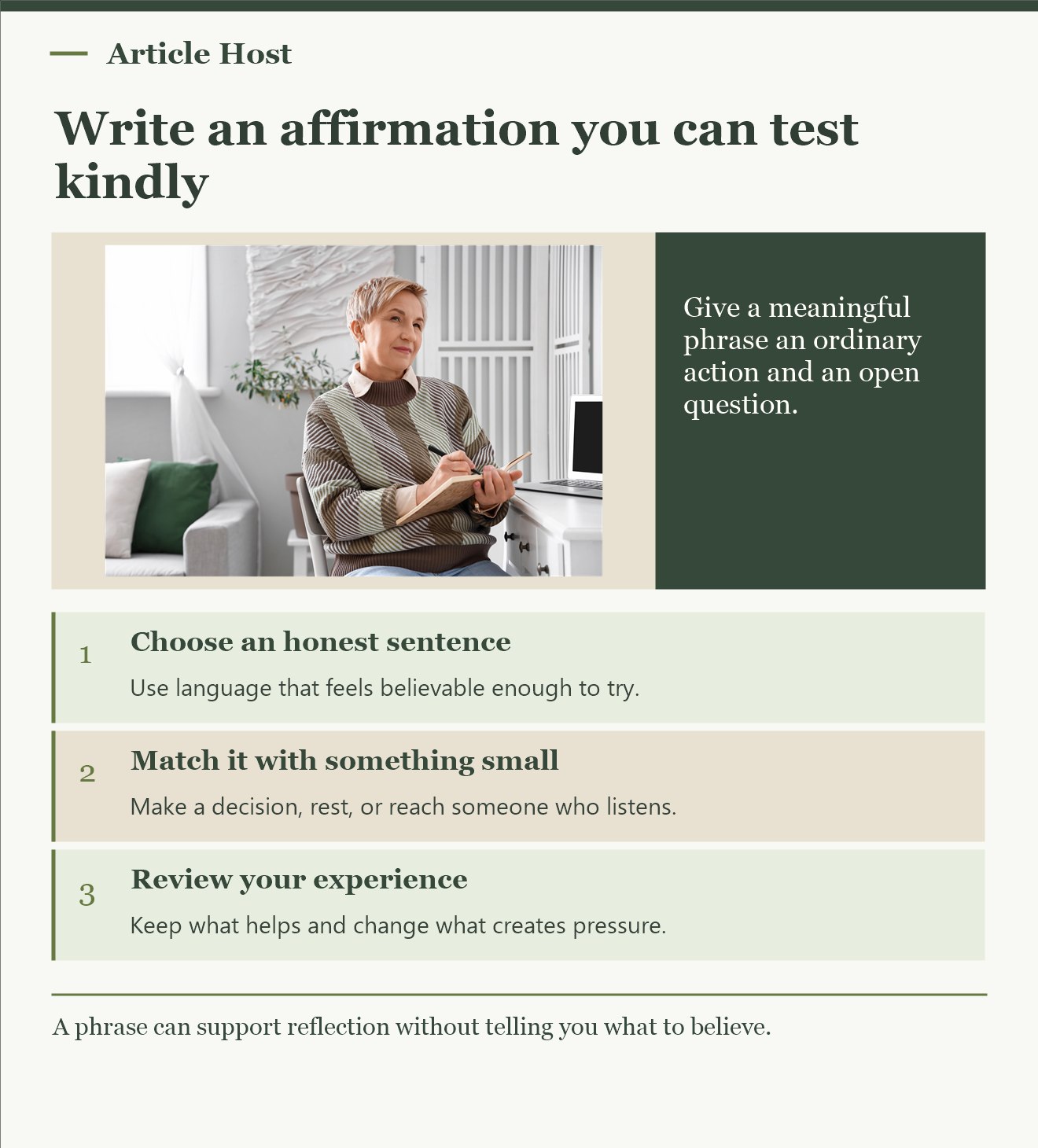
Write an affirmation you can test kindly
Give a meaningful phrase an ordinary action and an open question.
- Choose an honest sentence Use language that feels believable enough to try.
- Match it with something small Make a decision, rest, or reach someone who listens.
- Review your experience Keep what helps and change what creates pressure.
A phrase can support reflection without telling you what to believe.