

Being criticised, excluded from a group or drawn into an online argument can leave you unsure what to do next. The phrase “being cancelled” can describe very different situations. Before responding, identify the specific concern: a disagreement, a misunderstanding, feedback about harm, a broken relationship or targeted harassment.
Your feelings matter, and you can examine what happened without accepting insults or assuming that every criticism is unfair. These six reminders can help you choose a response that fits the situation, your responsibilities and your safety.
On this page
1. Your feelings deserve attention
You might feel embarrassed, angry, frightened, relieved or uncertain after a difficult exchange. You do not need other people’s permission to acknowledge those feelings. Try describing the experience plainly: “I felt humiliated when that message was shared,” or “I am worried about losing this friendship.”
A feeling gives you something to attend to, but it does not establish every fact about another person’s intentions. You can feel hurt and still need more information. Give yourself enough space to separate what was said from what you fear it means about your future.
It may help to write two short notes: “What I know” and “What I am assuming.” A direct message, a removed invitation or the words in a conversation belong in the first note. “Everyone now dislikes me” is an interpretation you may want to question. You do not have to resolve the whole situation while the feeling is strongest.
2. Specific behaviour is more useful than a label
Ask what needs a response. Did someone challenge an opinion? Say that your words hurt them? Spread an inaccurate claim? Repeatedly send insulting messages? The details matter more than deciding whether everyone would call the experience “cancel culture.”
Consider the setting and the relationship. A friend declining a conversation, an employer reviewing a complaint and strangers sending threats are different situations. A response that fits one may be unhelpful in another. Avoid assuming that you know someone’s motives from a single message.
- For a misunderstanding: identify the point that needs clarification and any missing context.
- For feedback: ask what action or words caused concern and listen to the answer.
- For a relationship boundary: notice what the person has asked for, including a request for space.
- For harassment: put support and safety ahead of winning the argument.
You can disagree with someone’s conclusion while still accurately describing their concern. A clear description also makes it easier to ask a trusted person for a useful perspective.
3. You can take responsibility without condemning yourself
If you said something inaccurate or caused harm, consider what needs correcting. Good intentions do not answer every concern about impact. Read or listen carefully before deciding whether a clarification, correction, apology or change in behaviour is appropriate.
A specific response is often clearer than a long defence of your character. For example: “I repeated that claim without checking it. I have corrected the post.” Or: “I interrupted you and dismissed what you were saying. I am sorry, and I will give you space to finish.” Use an example only when it describes what actually happened.
Taking responsibility does not require agreeing with every accusation. Separate the part you can acknowledge from the part you dispute, and avoid inventing certainty to make the conversation end. Other people may need time or may choose not to continue the relationship.
You can work on a mistake while keeping a fairer view of yourself. Our guide to How to Love Yourself Through Practical Care and Fairer Self-Talk offers ways to include your needs without pretending that mistakes do not matter.

4. You can choose when and how to respond
Before replying, decide what the reply is for. Are you correcting information for readers, repairing a private conversation, answering a formal request or stating a boundary? Keep the response focused on that purpose rather than trying to answer every comment.
You might say, “I want to understand the concern; can we discuss the specific statement?” Or: “I am willing to discuss the issue, but I will end the conversation if the insults continue.” Choose a boundary you can act on, such as leaving the conversation or limiting further replies.
A pause can be a deliberate choice. You may want to draft a response, ask someone to review its tone or return when you have the relevant information. Silence for now does not automatically mean agreement. Speaking immediately does not guarantee that others will understand you.
For help planning what to say, read Feeling Unsure? Practical Ways to Communicate with Confidence. If a workplace or other formal process is involved, use its stated procedure and seek appropriate advice for your circumstances.
5. Harassment calls for support and safety
You do not have to keep engaging with threatening or abusive messages to prove that your view is reasonable. If it is safe, preserve relevant evidence such as messages, dates, usernames and links before removing content or blocking an account. Report harmful material through the platform’s reporting tools.
Review who can contact you and what personal information is visible. Muting or limiting replies may help you step away while you decide what to do. If an investigation or safety plan is involved, ask the relevant adviser before changing access or deleting material.
Australia’s eSafety adult cyber-abuse guide explains preserving evidence, platform reporting and further support. Its formal reporting scheme has Australian eligibility requirements. Elsewhere, use appropriate local services. If threats put your immediate safety at risk, contact local emergency services.
6. Support can include both care and honest perspective
A supportive person can listen to your distress and help you consider something you may have missed. Look for someone who can keep private information private and discuss the actual situation, rather than encouraging retaliation or insisting that you must be right.
Make the request specific: “Can you help me decide whether this reply answers the concern?” or “Could you keep me company while I take a break from checking messages?” Ask before sharing distressing material or private details about someone else.
Our article Talking About Stress: Listening, Consent and Useful Support can help you plan that conversation. If distress continues to disrupt your sleep or daily life, consider support from a qualified mental-health professional.
Choose one next step you can review: clarify a fact, correct a mistake, hold a boundary, ask for help or leave a discussion. You cannot promise yourself universal approval. You can aim for a response that is accurate, proportionate and consistent with how you want to treat yourself and other people.
A three-part response when a post starts attracting attacks
Suppose people criticise a post because a quotation lacked context and others begin sending threats. Check the quotation first and correct the post clearly if needed. Ask a colleague or trusted person to read the correction before it goes up when time allows.
For threats or personal information shared without permission, use the relevant reporting route and preserve dates, accounts and links where safe. Ask someone for help with moderation if watching the replies is interfering with your ability to respond.
Read the infographic in text
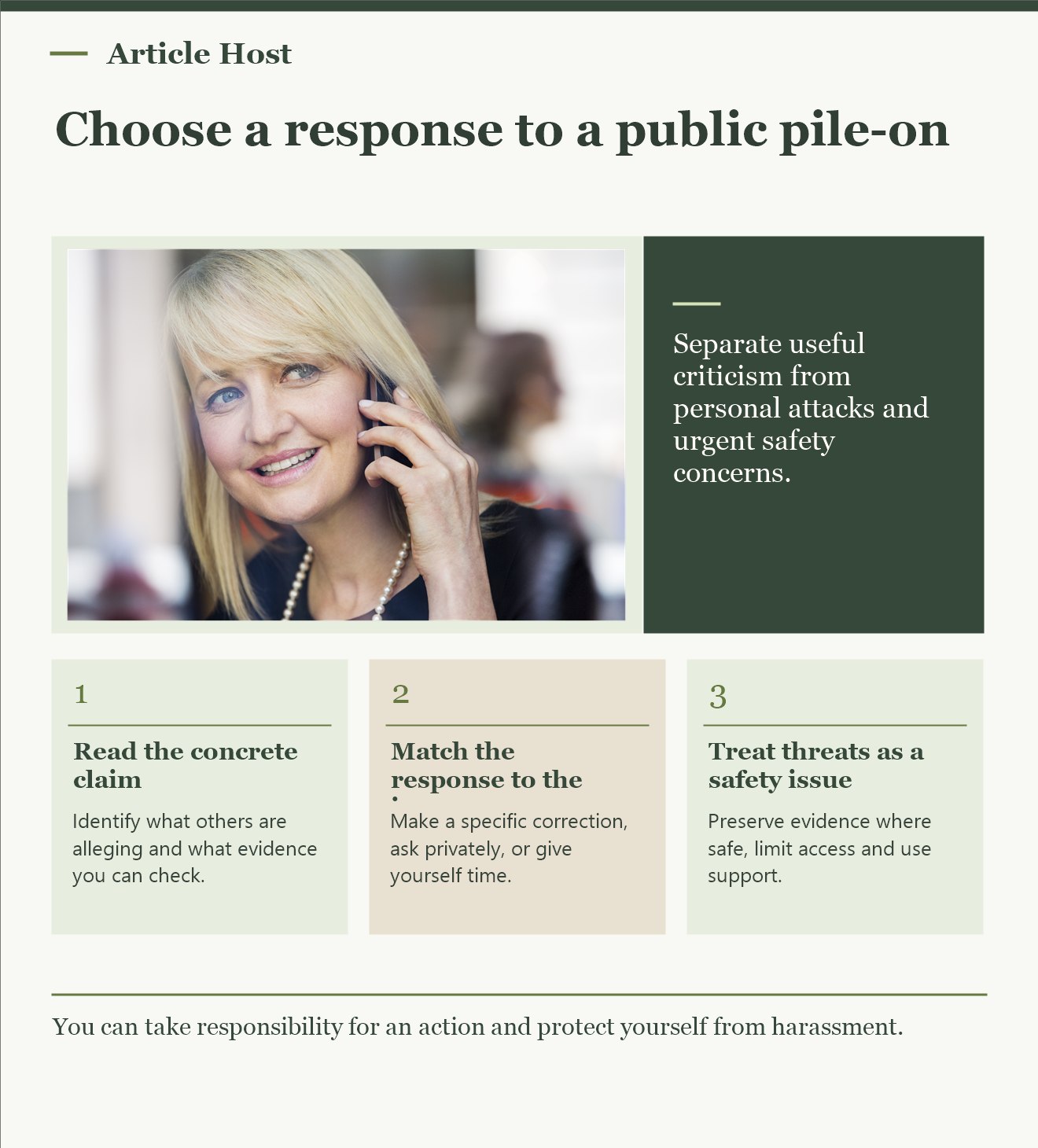
Choose a response to a public pile-on
Separate useful criticism from personal attacks and urgent safety concerns.
- Read the concrete claim Identify what others are alleging and what evidence you can check.
- Match the response to the issue Make a specific correction, ask privately, or give yourself time.
- Treat threats as a safety issue Preserve evidence where safe, limit access and use support.
You can take responsibility for an action and protect yourself from harassment.