

Being the best you can be does not require becoming a different person or improving every part of your life at once. A more useful starting point is to decide what matters to you, notice how your choices affect others and practise one change you can sustain.
Some seasons leave room for learning or a new project. Others call for rest, repair or keeping ordinary routines going. Your standards can reflect the life you are actually living. You do not have to feel impressive to make a thoughtful choice.
On this page
Define what doing well means to you
A borrowed standard can keep moving out of reach: earn more, look different, stay cheerful, never disappoint anyone. Replace that broad comparison with a quality you want to express in an ordinary situation. Reliability might mean telling someone when you cannot meet a deadline. Care might mean listening before offering advice.
Try finishing this sentence: “This week, I want to be more thoughtful about…” Choose something you can influence. You can prepare for a conversation or make a clear request; you cannot make another person approve of you.
Being present also has limits. You cannot give full attention to every task and person all day. For one conversation, you might put your phone aside, explain when you need to leave and ask what the other person wants you to understand. A small period of attention can be more realistic than promising constant availability.
Practise without turning mistakes into an identity
Choose a behaviour you can describe rather than a verdict about yourself. “I interrupted twice” gives you something to work on. “I am a terrible friend” does not tell you what to change. The next attempt might involve waiting until someone finishes or asking whether you understood them correctly.
Taking responsibility means acknowledging what you did, considering its impact and making a repair where possible. It does not mean accepting blame for someone else’s actions, denying unfair conditions or pretending you had resources that were unavailable.
Forgiveness is a personal choice, not a condition you must meet to move forward. You can process hurt, keep a boundary and decide against renewed contact. If you harmed someone else, an apology should identify your action and what you will change; it cannot require them to forgive you.
Evaluate opportunities before saying yes
A new class, a date or a different job can be worth considering without automatically being the right next step. Before committing, check the cost, time, support and possible consequences. Being afraid does not always mean something is unsafe, and feeling excited does not establish that it is a good fit.
- What interests me? Name the actual experience or skill you want.
- What would it require? Include travel, preparation, money and recovery time.
- Can I try a smaller version? A short introductory session may answer a question before a larger commitment.
- What would make me stop? Decide which limits you want to respect.
Honesty can be simple: “I am interested, but I need to check my schedule,” or “I cannot commit to that.” You do not need an elaborate excuse. Where a choice affects others, discuss the relevant details before making promises on their behalf.

Protect time for what matters
Look at a typical week before adding a new goal. What already needs your attention? What can be shortened, shared or postponed? A plan that depends on having unlimited energy will be difficult to maintain.
Saying yes is useful when it is a choice you can support. Saying no, asking for more information or delaying a decision can be equally thoughtful. You are allowed to decline an opportunity that is worthwhile for somebody else.
Work, relationships, rest and enjoyment do not always divide into equal portions. Instead of chasing a perfect balance, protect one realistic space: a meal away from a task, a short conversation or an evening without another optional commitment. For more ideas, read Self-Care When Others Need You: Time, Limits and Practical Help.
If gratitude is helpful to you, notice something specific you appreciate. You do not have to feel thankful for mistreatment or turn a painful event into a lesson. Appreciation and a wish for change can exist together.
Review your choices fairly
At the end of the week, ask what you tried, what it required and what you learned. Include the constraints around the result. An unfinished task may need more time, clearer instructions or help, rather than harsher self-talk.
Keep one practice that was useful, adjust one that was too demanding and acknowledge any repair still needed. You can take your actions seriously while treating yourself as someone worth caring for throughout the process.
Choose a useful yardstick before saying yes
Suppose you are offered a committee role that looks impressive but meets on your only quiet evening. Decide what you want that role to do for you. Ask whether a short project would give you similar practice without giving up a routine you count on.
Check the arrangement after a month. Consider what you contributed, what you learned and whether your week still leaves room for the people and activities you value.
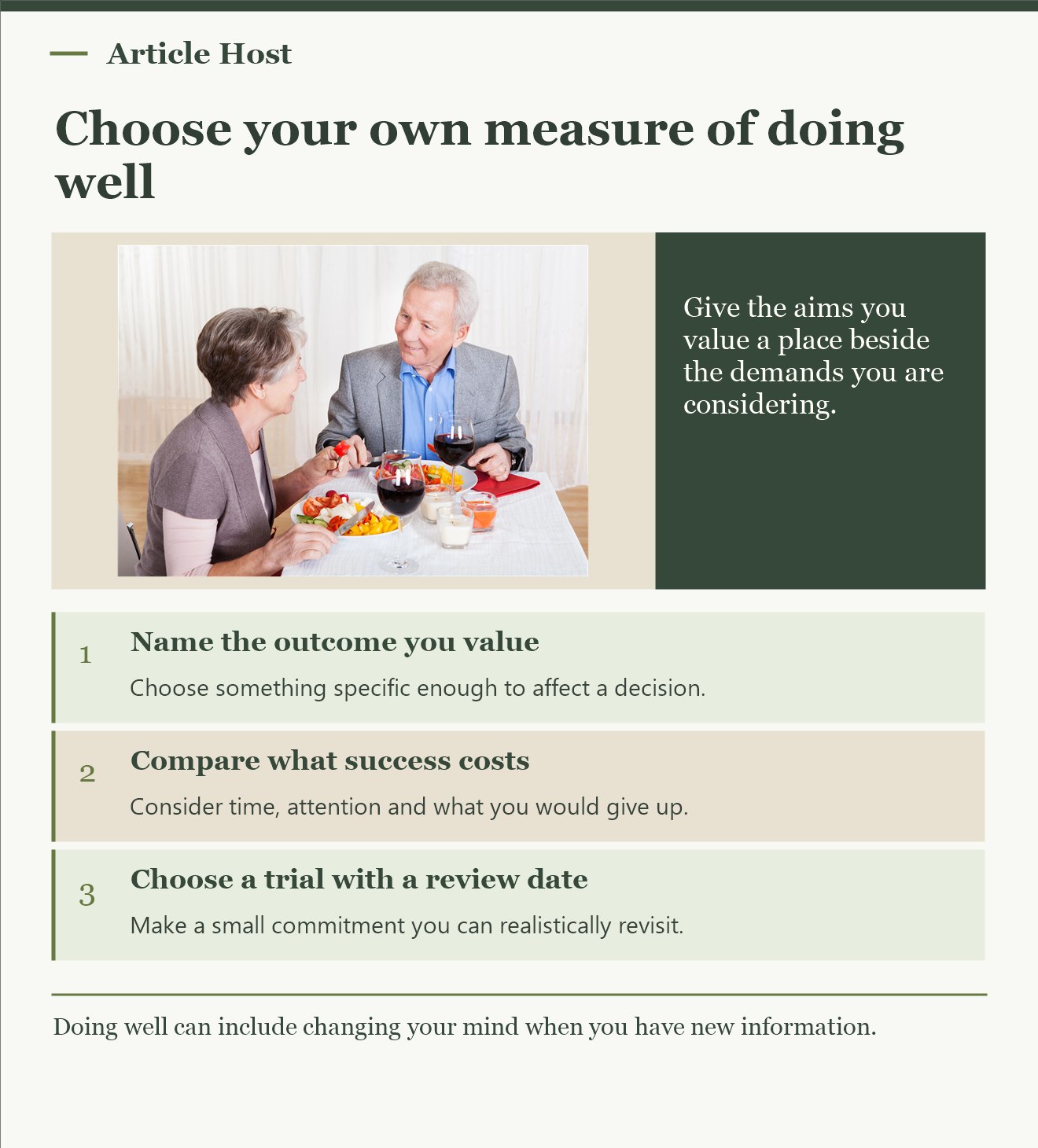
Read the infographic in text
Choose your own measure of doing well
Give the aims you value a place beside the demands you are considering.
- Name the outcome you value Choose something specific enough to affect a decision.
- Compare what success costs Consider time, attention and what you would give up.
- Choose a trial with a review date Make a small commitment you can realistically revisit.
Doing well can include changing your mind when you have new information.