

Vulnerability can mean admitting that you care, do not know something or need help when you cannot be certain how another person will respond. It may make an honest conversation possible. It does not require you to reveal everything, ignore your limits or accept hurtful treatment.
Feeling empowered can be as simple as choosing what to say and what to keep private. You can practise openness gradually, with people who show respect through their actions, while keeping control of your own pace.
On this page
Choose what you want the conversation to do
Before opening up, ask what would be useful. Do you want someone to understand your feelings, help with a task, consider a change or simply listen? You do not need a perfect explanation. A clear starting point can make the conversation easier to follow.
For example: “I have been finding evenings difficult. Could you listen for a few minutes before offering ideas?” Or: “I am not sure how to do this part. Can we work through one example?” These are ordinary requests, not tests of how brave or emotionally developed you are.
You can also name uncertainty: “I want to talk about this, but I am still finding the words.” Writing a few notes beforehand may help. Being honest about one small thing can be enough for now.
Let trust guide how much you share
Consider how the person has handled smaller disclosures. Have they listened without ridicule? Respected a refusal? Kept personal information private when asked? An affectionate promise is useful only alongside behaviour you can rely on.
Start with information you are comfortable sharing and notice the response. You can say that something is personal and ask how they would handle it before discussing the details. In a group, workplace or online space, think about who else may hear, record or pass on what you say.
If you are considering counselling, you can begin by asking about the counsellor’s qualifications, approach, confidentiality and its limits. You can also ask how they work with someone who finds it difficult to talk. You do not have to arrive ready to tell your whole story.
Keep boundaries alongside openness
Privacy and connection can exist together. You may be ready to discuss how something affects you without describing the event itself. You may want a conversation with one trusted person while keeping the subject out of a family group chat.
Try a boundary that describes what you need:
- “I can talk about how I am feeling, but I am not ready for questions about the details.”
- “Please ask before sharing this with anyone else.”
- “I need to pause. I will let you know if I want to return to it.”
Someone else’s disappointment does not remove your choice. If a person pressures, threatens or mocks you, sharing more is not an obligation. Prioritise your safety and consider support outside that relationship when it is safe to seek it.

Make room for listening and a real response
Choose a time when both people have some attention available. “Is now a good time for something personal?” allows the other person to be honest about their capacity. A respectful “not right now” can be followed by a specific alternative.
If you are listening, check what the person wants before giving advice. You might say, “Would you like ideas, practical help or just some company?” Ask when you are unsure, rather than deciding that you know what their experience means.
The NHS guide to healthy relationships discusses honest communication, listening and boundaries together. Openness is most useful when respect goes both ways; one person should not have to carry every difficult conversation.
Review the experience and choose your next step
Afterwards, notice what happened rather than grading your performance. Were you heard? Was your boundary respected? Did the conversation give you useful information about the relationship? Feeling exposed for a while does not automatically mean you shared too much, but discomfort is worth paying attention to.
A clumsy response may be something you can discuss: “I wanted listening, and the quick advice left me feeling unheard.” Repeated dismissiveness or broken confidence gives you a reason to change what you share or who you turn to. You cannot make someone trustworthy by explaining yourself more thoroughly.
You can decide to try again, say less, choose a different person or seek professional support. Vulnerability does not need to become a project of constant self-disclosure. A useful step leaves room for both connection and your right to choose.
Read the infographic in text
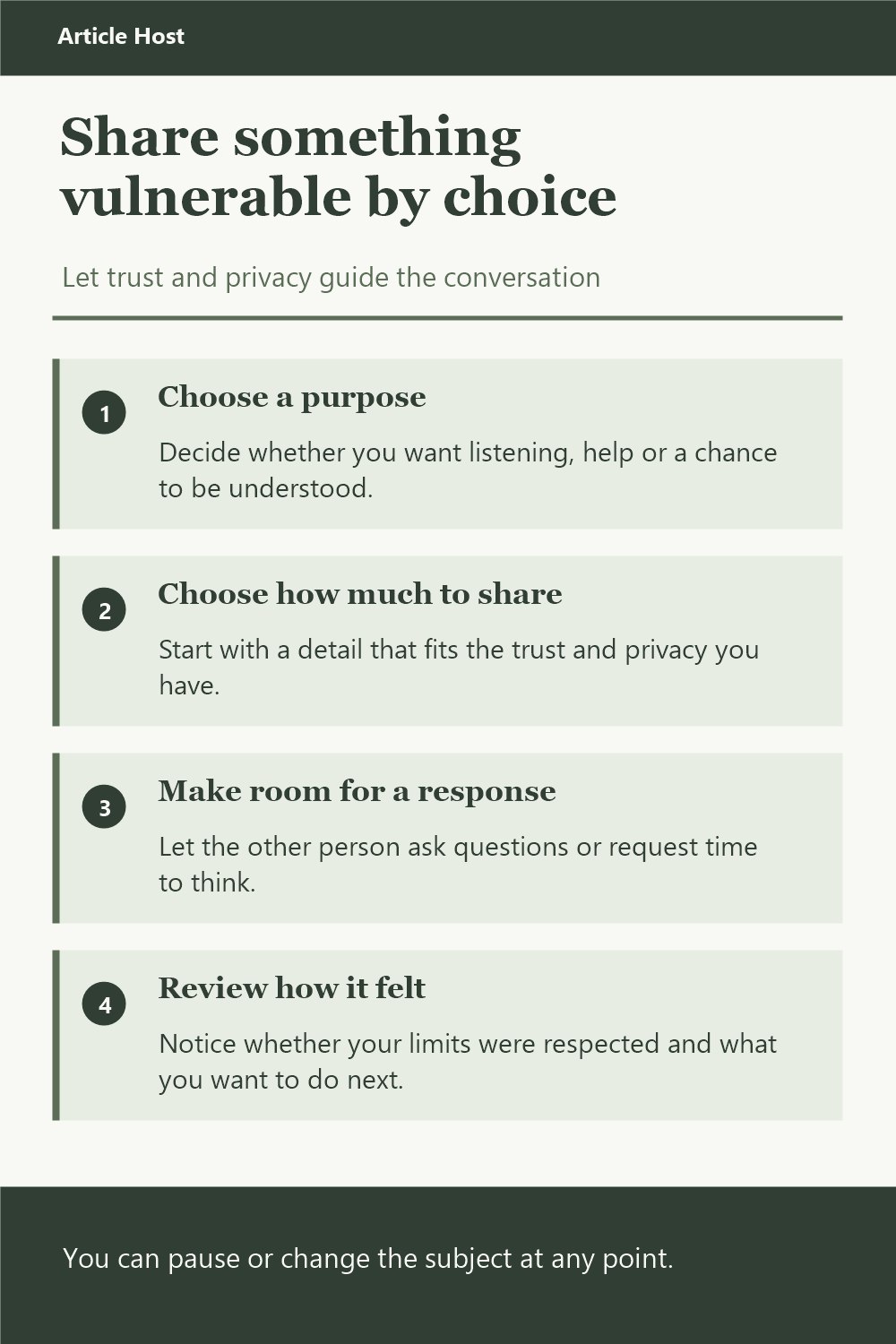
Share something vulnerable by choice
Let trust and privacy guide the conversation
- Choose a purpose Decide whether you want listening, help or a chance to be understood.
- Choose how much to share Start with a detail that fits the trust and privacy you have.
- Make room for a response Let the other person ask questions or request time to think.
- Review how it felt Notice whether your limits were respected and what you want to do next.
You can pause or change the subject at any point.