

Looking back on childhood can raise difficult questions about whose feelings had room in your family. Perhaps distress was repeatedly ignored, needing comfort was treated as weakness or you learned to keep important things to yourself. These experiences deserve thoughtful attention without turning a list of adult feelings into proof of what happened.
Childhood emotional neglect concerns emotional needs that went unmet. Feeling lonely, independent or unsure of yourself today does not establish that history on its own. You can take current difficulties seriously while remaining uncertain about some parts of the past.
On this page
Describe what you remember without a checklist verdict
The NSPCC information on emotional abuse and neglect describes persistent emotional mistreatment, including repeatedly ignoring a child. A single distracted moment, a family disagreement or a photograph cannot establish a pattern of neglect.
If reflection feels useful, distinguish an event you remember from an interpretation: “When I cried, I was regularly told to leave the room,” rather than “Every difficulty I have now must come from childhood.” Both memories and uncertainty can be discussed with a qualified professional.
You do not need to force yourself to recover memories, assign a diagnosis to a parent or decide on a complete explanation before seeking support. Stop an exercise if it leaves you more distressed or unable to return to your day.

Explore support in small, chosen steps
Depending on someone can feel uncomfortable for many reasons. Instead of treating independence as a symptom, consider whether you can ask for help when you want or need it, and whether the people available to you respond respectfully.
Try a limited request with someone you trust: “Could you listen for a few minutes?” or “Can you help me work out the next step?” You can say how much you want to share. You do not owe a full account of childhood to earn ordinary kindness.
Notice the response over time. Does the person listen, respect a refusal and keep private information private? A relationship does not become safe simply because you disclose more. These ideas for making room for your needs when you want connection can help you think about present choices.
Respond to self-criticism with something specific
If your mind says “I am flawed,” try naming the actual difficulty: “I am finding it hard to explain what I need,” or “I am upset after that conversation.” A specific description leaves room for an action, a request or support.
Shame and guilt are feelings to notice, not reliable evidence that you deserved neglect. If you made a current mistake, you can address that particular action. Responsibility for an adult’s treatment of a child belonged to the adult.
You do not have to replace every painful thought with a positive statement. You might simply say, “This is hard, and I can ask for help.” If self-criticism becomes overwhelming, these suggestions for finding support when you think “I hate myself” offer another place to begin.
Choose boundaries for present relationships
Understanding a difficult childhood does not require immediate confrontation, forgiveness, reconciliation or cutting off contact. Consider your current safety, practical dependence, preferences and available support before deciding what contact is workable.
A boundary might involve a shorter visit, declining one topic or taking time before replying. Where threats, control or retaliation are concerns, seek individual support before announcing a change. You are not required to persuade another person to agree with your memories.
Find help at a pace you can manage
A healthcare professional or counsellor experienced in childhood abuse and neglect can help you discuss current difficulties and possible support. You can ask about their approach, fees, confidentiality and experience before deciding whether to continue.
The UK-based NSPCC guidance for adults affected by childhood abuse explains options for talking to someone and finding further help. Elsewhere, ask a local healthcare or survivor-support service about available care.
If a child may currently be at risk, contact the appropriate local child-protection service for advice; use emergency services for immediate danger. Reflection about your own childhood and action to protect a child are separate needs. Neither requires you to manage everything alone.
Practise asking for listening when advice feels overwhelming
You tell someone you had a hard day and they immediately start listing tasks you should do. You might pause and say, “Could you listen for a couple of minutes before we try to fix anything?” Start with someone who can respect your pace.
Later, note if being heard changed what you needed or how you felt. Working with a qualified mental health professional may help if earlier experiences are still affecting daily life or relationships.
Read the infographic in text
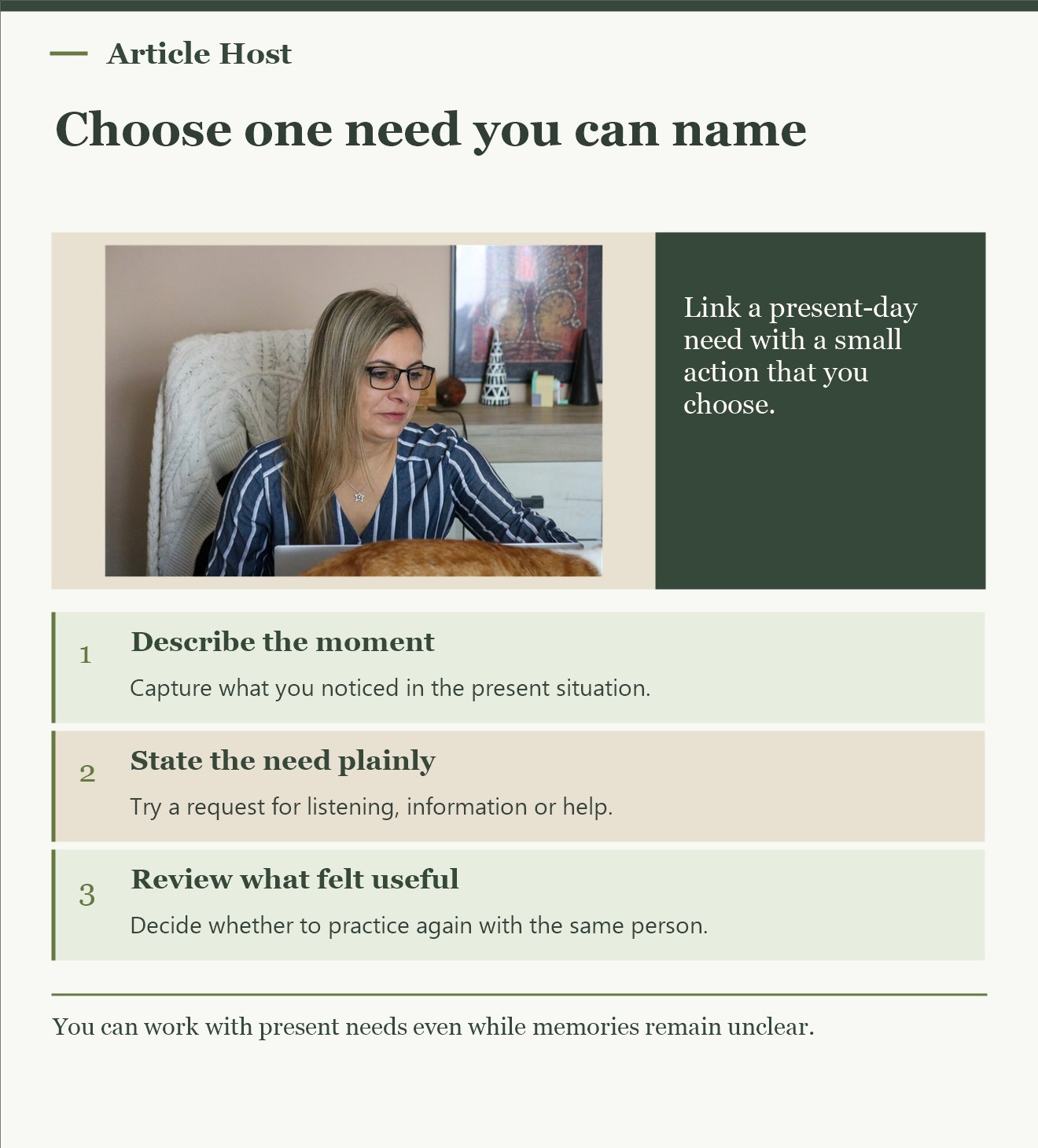
Choose one need you can name
Link a present-day need with a small action that you choose.
- Describe the moment Capture what you noticed in the present situation.
- State the need plainly Try a request for listening, information or help.
- Review what felt useful Decide whether to practice again with the same person.
You can work with present needs even while memories remain unclear.