

Preparing can be useful when it answers a decision you need to make before starting. If you keep collecting options and the next action stays the same, choose a small, reversible part of the work to try.
Name the information that actually changes the action
When you’re working on something new, it’s easy to spend more time researching than actually making progress. You might keep looking for ideas, reading articles, or comparing different options because you want to make sure, you’re doing everything correctly. But not every piece of information you find is necessary for the part of the project you’re currently working on.
One way to make things easier is to separate the information you need right now from the things that might be useful later. For example, imagine that you’re creating an invitation for a family reunion. Before you can start putting it together, you’ll need to know the date, time, location, and who will be invited. But you probably don’t need to spend several hours looking at different invitation styles or researching every possible design before you can create a first draft.
The same idea applies to school assignments, work projects, and other responsibilities. If you’re writing the first draft of a paper, you might need to understand the assignment instructions and gather enough information to begin. But you don’t necessarily need to have every sentence perfected, or the entire document formatted before you’ve written anything.
Keep required checks in place
Some tasks have important requirements that you shouldn’t ignore. If you’re submitting a final assignment, sending information to a client, or completing something that involves safety, accuracy, or specific instructions, you’ll need to make sure those requirements are met. The difference is knowing what matters for the step you’re working on instead of trying to complete every part of the project at once.
Make one small thing
Pick a small piece of work, such as a paragraph, a list of documents, a calculation, or a draft for a person who can clarify the brief. This doesn’t have to be something that’s ready to share with the public. Label it as a draft or an example so that it can be evaluated.
Maybe you want to write a guide, but you keep comparing the note-taking apps. You write one explanation using the tool. The paragraph shows missing facts and an unclear audience. This information is more helpful than comparing another app because it comes from attempting the task. The next plan can respond to the problem.
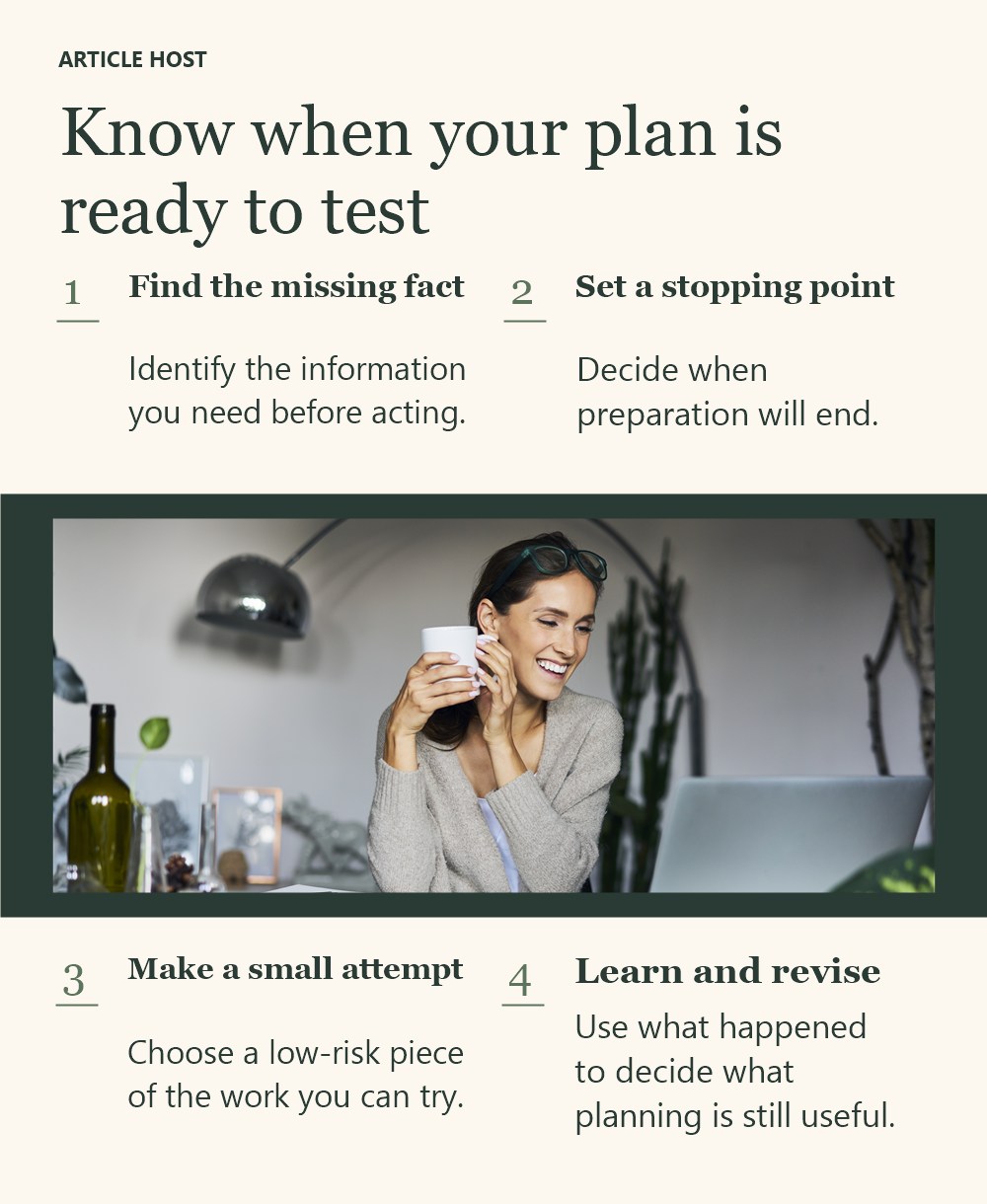
Read the visual guide as text
- Find the missing fact. Identify the information you need before acting.
- Set a stopping point. Decide when preparation will end.
- Make a small attempt. Choose a low-risk piece of the work you can try.
- Learn and revise. Use what happened to decide what planning is still useful.
Set a limit on preparation
You could also give yourself a certain amount of time to prepare before moving on to the actual work. Maybe you decide to spend thirty minutes organizing your ideas and then start writing your first paragraph. But remember that a time limit shouldn’t mean ignoring something important. If you’re missing information that’s necessary for safety, accuracy, or meeting a requirement, it’s better to get the answers you need before continuing.
The important thing is making sure that your planning eventually leads to progress. You don’t have to know exactly how every part of a project will turn out before you begin. Sometimes getting started helps you recognize what needs more attention, and you can make changes as you go.
Stick with a tool through one trial
Have you ever spent more time looking for the perfect planner, notebook, or app than actually completing the things you wanted to organize? Sometimes trying a new system can feel exciting because it gives you the impression that you’re making a fresh start. But switching from one system to another can also take time away from the work you’re trying to accomplish.
Think of a woman named Melissa uses a notebook to keep track of her household responsibilities and appointments. One day, she sees a new planning app that promises to make organizing everything easier. She spends several hours setting it up, entering information, and learning how it works. By the end of the day, she hasn’t actually completed any of the tasks she originally planned to do.
Before changing the way, you organize your work, think about what’s wrong with the system you’re already using. Is it missing something you actually need, or are you just hoping that something new will make you feel more motivated? If your current notebook, calendar, or computer program is helping you stay organized, there might not be a reason to replace it.
Decide what you can do while waiting
Sometimes you can’t move forward with a project because you’re waiting for someone else to provide information, approve something, or give you access to what you need. When this happens, it’s easy to feel like you’re falling behind, even though the delay isn’t something you can fix on your own. Instead of getting frustrated with yourself, try figuring out exactly what’s missing and who you need to contact.
Think about if you’re creating a flyer for a community fundraiser, but the organizer hasn’t confirmed the location. You can still work on the design and prepare the general information, but you can’t finish the flyer without knowing where the event will take place. Instead of guessing or repeatedly changing your schedule, you could contact the organizer and ask when the location will be confirmed.

Let a first attempt show you what matters
When you’re starting something new, you might feel like you need to have every step planned before you can begin. But sometimes the best way to figure out what needs to happen next is by trying a small part of the task. This can help you recognize what you understand, what information you’re missing, and what might be more difficult than you expected.
Look for workload and access barriers
If someone has too many responsibilities, any plan can be unrealistic. A more detailed schedule doesn’t create missing time or support. Look at the commitments. What could be removed, shared, delayed, or renegotiated? If nothing fits, then the next best action might be having a conversation.
Rest is different than avoidance. Taking a break can support a later action, especially if you leave a clear return point. If you’re too exhausted, moody, or anxious, then you should get qualified professional help. Don’t make a planning technique responsible for explaining everything you’re going through. Regular conditions and health needs need to be assessed too.
What Did the Plan Help You Do?
Use a small attempt to answer a real question
Define what the trial will tell you. If you’re unsure how much time a proposal needs, outline the first section and see where you get stuck. If access or approval is missing, list the decisions that depend on it and work only on a reversible part. The Centre for Clinical Interventions’ procrastination resources offer more ways to identify and test barriers.
Related reading. Perfectionism and high standards.
Turn your next planning session into a small test
A work proposal that keeps collecting notes
Write the first section and send the outline to one reviewer with a question. “Does this answer the decision we need to make?” Their reply can tell you which research to do next.
A home project with a decision still open
Before comparing more storage systems, clear one shelf and try the boxes you have for a week. Write down what fits and what still needs a home. The trial gives you better measurements for any purchase.
When the missing information is a real dependency
If a client still needs to approve the budget, confirm who can approve it and when. Use the waiting time to draft a reversible sketch. Mark the decision you need before purchasing or committing resources.
Write a test in one sentence
“I’ll try [small reversible action] by [time] so I can learn [specific fact]. Afterward, I’ll keep, change or stop [one part of the plan].”
Frequently asked questions
1. How can I tell whether planning has become procrastination?
Ask which decision the next bit of preparation will change. If you can name a small safe action with what you already know, try it and use what happens as information.
2. What should I do before starting a higher-stakes task?
Find out what approvals, information or safety checks are required. Use a low-risk preparation step while you wait for any dependency.
3. What does a useful preparation limit look like?
Choose a stop time and state the action that follows it. For example, after 15 minutes checking the brief, draft the first paragraph.
4. Should I change tools if a planner isn’t helping?
Identify the obstacle first. If the current tool can hold the immediate task, try one short work session before deciding whether a different tool is needed.
5. What if I can’t proceed until someone replies?
Send a specific question and note what depends on the answer. Work on a reversible part that needs no guesswork, or switch to another priority.