

Finishing work when perfectionism keeps you checking can take a different skill from making the work better. Decide what the task has to do, which details deserve review and what action will mark the handoff.
Write the finish line before your last edit
List the requirements in plain language. If you’re doing a report, it might mean answering questions, checking figures, looking for sources, and then doing the agreed format.
Use the brief, instructions, and professional procedures, and don’t keep adding your own requirements because a bigger version exists somewhere online. The task can be done without it being the best thing that’s ever been produced.
According to the Centre for Clinical Interventions’ perfectionism resources it distinguishes healthy standards from demanding standards that continue despite significant costs. A finish list helps make the standard visible. It should be specific enough to check and short enough to use. If it becomes another sprawling project, return to the purpose and identify what is essential.
Sort errors and preferences
An error changes accuracy, meaning, usability, or compliance with a real requirement. A preference concerns which acceptable version you like more. Both may deserve attention, but they do not carry the same weight.
Changing an incorrect date is necessary. Choosing between two clear introductory sentences may be optional. Fixing an inaccessible document structure can matter to its users. Repeatedly adjusting a decorative detail may add little.
Ask something like, “What becomes worse for the reader or user if I leave this as it is?” Answer concretely. If the only answer is that you might feel uncomfortable, you have identified a feeling rather than a defect. The feeling is real and may need support, but it does not automatically create more work for the task.
Match the review to the stakes
A personal message and a safety procedure shouldn’t use the same review process. Follow professional, legal, clinical, or organizational requirements for the work that has big consequences.
If you’re doing lower-stakes work, figure out what a good review should include. You might look at the fix, check for clarity, and make sure the right attachments are there. Don’t import a big process just because you want the work to feel large.
Emotional intensity doesn’t always match the risk. A short invite might feel scary, but an important numerical error might feel ordinary. Use the consequence and the standards to guide your review. If you’re not sure about the risk, talk to the right person. The purpose is to put in enough care and attention when it matters and have a stopping point when it doesn’t.
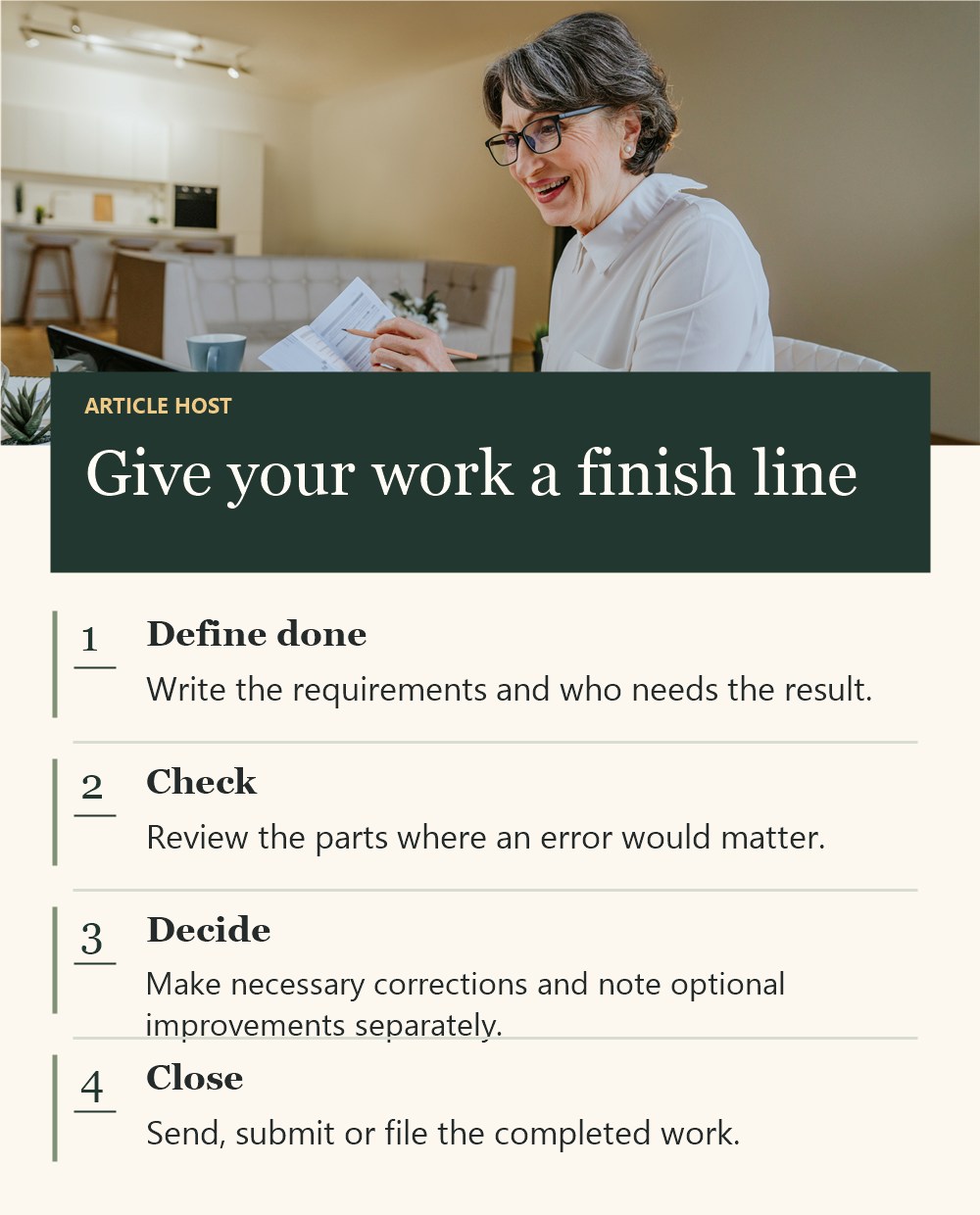
Read the visual guide as text
- Define done. Write the requirements and who needs the result.
- Check. Review the parts where an error would matter.
- Decide. Make necessary corrections and note optional improvements separately.
- Close. Send, submit or file the completed work.
Ask for feedback that answers a question
Getting another person’s opinion can be helpful when you’re trying to finish an important project. But instead of asking several people if they think your work is good enough, try asking someone you trust to look at something specific. This can help you get feedback that actually improves your work without leaving you with even more questions about what you should change.
If you’re writing a paper for school, you might ask someone if your main idea is easy to understand or if your conclusion connects to the rest of the paper. If you’re preparing a presentation, you could ask if the information is organized in a way that’s easy to follow. These questions give the other person something specific to focus on instead of asking them to judge the entire project.
It’s also helpful to explain how close you are to finishing and when the project needs to be completed. Someone might suggest changing the entire layout of your presentation when all you really need is someone to check for mistakes. You can appreciate their ideas without feeling like you have to make every change they recommend.
Choose when to reopen completed work
Maybe you finish the work, close the file, and then think of one more thing that might have been a mistake. Stop before you reopen it and ask if you have new information or if it’s just uncertainty and a new feeling.
If you have a concern, look at it against the final list. You could say something like, “I might have attached the wrong file.” This is something you can check instead of saying, “What if someone doesn’t like it?” This can’t be known just by reviewing it again.
According to the CCI procrastination resources it discusses delaying important tasks and the processes that keep delay going. Finishing can be the part you postpone. Recognizing that pattern lets you choose a next action deliberately instead of treating every new doubt as an instruction to restart.
Repair a mistake after delivery
Even when you take your time and carefully review your work, there’s always a possibility that you’ll notice a mistake after you’ve finished. Maybe you included the wrong date, forgot an important detail, or realized that something you wrote wasn’t completely accurate. When this happens, the best thing you can do is correct the problem instead of allowing one mistake to make you question the entire project.
Think about a woman named Stephanie creates a flyer for a community fundraiser. After sharing it with several people, she realizes that she accidentally listed the event as starting at 5:00 instead of 6:00. Rather than becoming overwhelmed and worrying about everything else on the flyer, she updates the original document and sends a message explaining the correct starting time.
Stephanie also decides that she’ll make a point of checking event dates and times against the original information before sharing future announcements. This helps her learn from what happened without feeling like she needs to completely change the way she handles every project.
Check the conditions you are working in
Unclear expectations, last-minute changes, too much of a workload, and small responses to ordinary mistakes can make stopping hard. Don’t just think that every finishing problem comes from your own mindset.
Know your priorities, write down agreements that are important when needed, and ask who can decide when requirements are conflicting. You might need to change a task or get help from someone else.
Notice if personal difficulties, such as stress, checking, or avoidance, are interfering with your life. Talking to a qualified mental health professional can help look at the overall picture. An article can’t tell you the cause, but you can get support while still making practical changes to deadlines, briefs, and the review process. These are two things that can work together.
Finish a task you can practise on
Pick a task, name it, and write down the requirements.
Compare any meaningful corrections, then figure out a stopping action.
Pay attention to what you learned instead of asking if you felt confident throughout the whole thing. You might find out that a clear brief mattered more than adding more effort, or that the hard part was dealing with the moment after you sent it.

Give a small task an explicit stopping action
Write a one-line definition of done before the final review. Circle the items that could change the outcome or create a problem for the reader. Check those, then set a stopping action you can see, such as uploading the final version. The Centre for Clinical Interventions’ perfectionism resources offer exercises for exploring how strict rules affect your work.
Related reading. Perfectionism or High Standards? How to Tell Them Apart.
Decide what counts as finished in three common situations
A job application
Before editing again, check that your résumé opens, the examples relate to the advertised role and the employer’s requested documents are attached. Save optional wording changes for a future application. The closing action for this one is to submit and save the confirmation.
A team document with one uncertain number
Check where the number came from and whether anyone will make a decision based on it. If it needs verification, get the source or mark it as pending in a review copy. Send the final version after the required checks. If you only want to try a different heading style, put it on a later list.
A creative project you can keep revising
Set a test before reopening the file. For a portfolio page, ask someone whether they can tell what you contributed and find your contact link. Fix the problem their answer reveals. Then publish this version and pick a future date to review it.
Write your own finish rule
Complete this sentence before the last pass. “I’ll send [deliverable] to [person] after I check [requirements and risks]. I’ll reopen it if [specific problem that affects the result].” Keep any required approvals, accuracy checks, or accessibility reviews in that rule.
Frequently asked questions
1. How can I tell when a task is ready to finish?
Check it against the agreed requirements. Give important details a proportionate final review and choose a specific handoff action.
2. Should I put a time limit on proofreading?
A time limit can help with low-stakes work. Budget enough time for any review required by the consequences of an error or the people relying on the work.
3. How do I ask for useful feedback?
Ask a specific question tied to the requirements, such as whether a colleague can find the next step or whether a figure matches the source.
4. What if I notice a real error after sending?
Check how the error affects the recipient. Send a concise correction when it changes the result, and explain which version they should use.
5. What if the requirements keep changing?
Ask who can settle the priorities. Record the change and agree on its effect on scope, timing and review before continuing.