

High standards can support careful work and learning. Perfectionism becomes costly when a task feels like a test of your worth, mistakes feel intolerable or checking prevents you from finishing. The distinction is easier to see in what happens when things do not go to plan.
Look at flexibility, not just effort
Two people may prepare equally carefully. One can adjust after feedback and submit work that meets the requirements. The other may keep revising long after the practical benefit has ended, afraid that an ordinary mistake will expose them as inadequate.
This is a pattern to reflect on, not a diagnosis. Ask whether your standard helps the task or keeps moving the finishing line. Consider the consequences for time, sleep, relationships and opportunities.
Define what the task actually requires
Before starting, identify the purpose, audience, deadline and real consequences of an error. A safety procedure needs a different level of checking from a casual invitation. “Good enough” means appropriate to the task, not careless.
- What must be accurate or complete?
- Which requirements come from the actual brief?
- Which extra rules have I added?
- What check would reasonably establish that I can finish?
If the requirements are unclear, ask for clarification. Trying to exceed an imagined standard can create work that nobody needs.
Notice the hidden costs
Perfectionism can look productive while making progress harder. You might spend an hour choosing a heading instead of completing the document, avoid applying because your experience is not ideal, or ask several people to reassure you about the same decision.
Look at the function of the behavior. Is another check likely to find a meaningful error, or are you hoping it will remove all uncertainty? Certainty may remain unavailable even after more work.
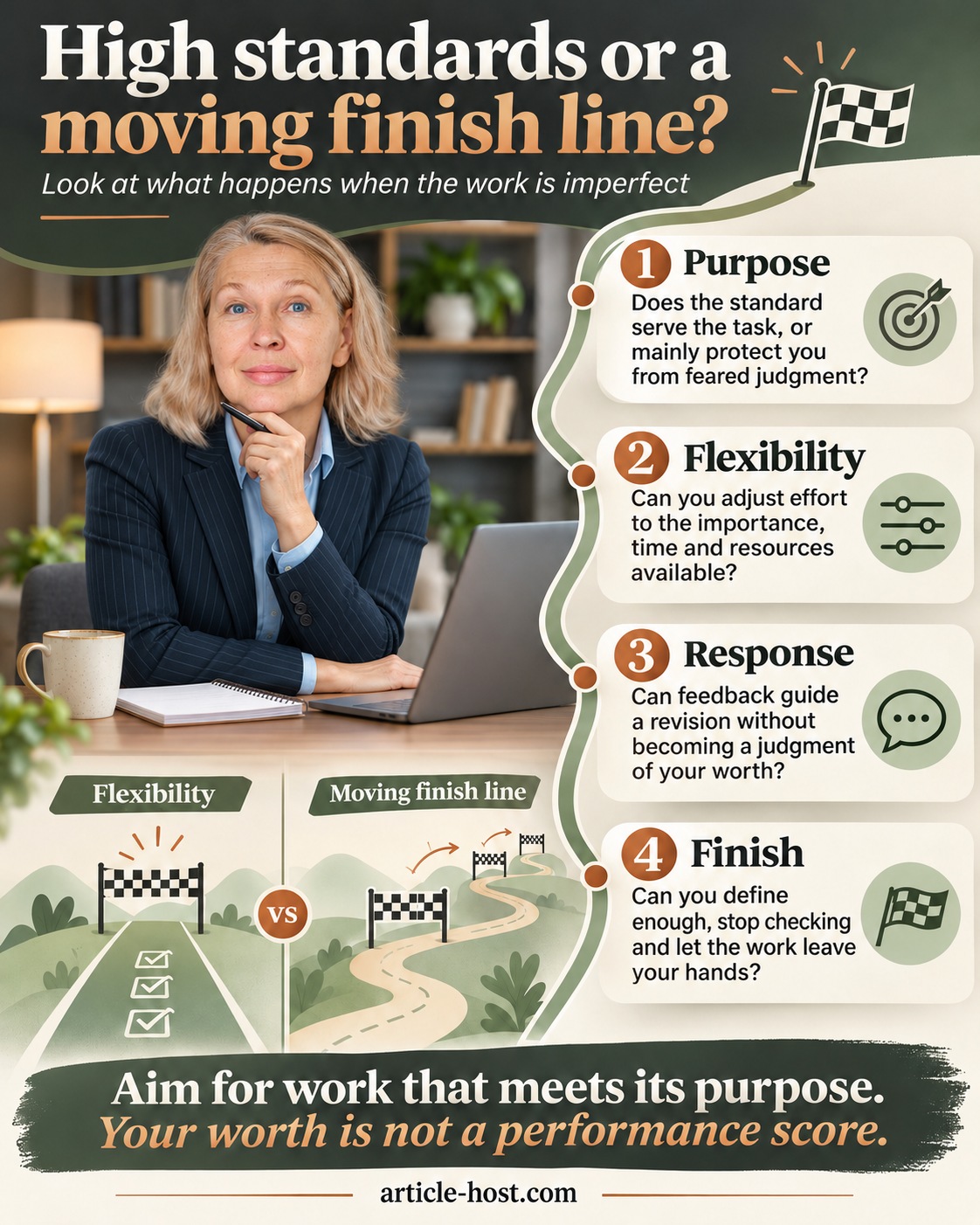
Read the visual guide as text
- Purpose. Does the standard serve the task, or mainly protect you from feared judgment?
- Flexibility. Can you adjust effort to the importance, time and resources available?
- Response. Can feedback guide a revision without becoming a judgment of your worth?
- Finish. Can you define enough, stop checking and let the work leave your hands?
Aim for work that meets its purpose. Your worth is not a performance score.

Practice finishing on a low-stakes task
Choose something with limited consequences: a routine message, a personal note or an ordinary household choice. Decide the required content and a reasonable finishing point, make the relevant check, then stop.
You do not have to start with a task involving health, legal obligations, money at risk or another person’s safety. Keep required professional checks. The aim is to loosen unnecessary rules where there is room to do so.
Afterward, notice what happened rather than repeatedly reviewing whether you did the exercise correctly. This practice should not become a new perfection standard.
Treat feedback as information
When feedback arrives, separate the requested change from a judgment about your identity. Ask:
- What exactly needs changing? Name the sentence, calculation, decision or behavior.
- What can I learn? Identify one useful adjustment.
- What remains unchanged? A correction does not erase everything that worked.
You can take responsibility for a mistake without describing yourself as a failure. If feedback is vague, request a concrete example and the expected outcome.
Keep ambition while changing the rules
You may still value excellence, reliability and improvement. Try giving each of those values a practical definition: meet the brief, communicate a delay, correct an error and learn for next time. None requires being beyond criticism.
Your environment matters too. Impossible workloads, unclear expectations or punitive responses to ordinary mistakes are not solved by becoming more disciplined. Where possible, clarify priorities and ask for realistic limits or support.
If checking, avoidance, distress or self-criticism persist and interfere with daily life, consider qualified mental health support. You do not need to abandon your goals to ask for help. A useful standard lets you complete meaningful work and remain a person whose worth extends beyond the result.