

When motivation is low, even an ordinary task can feel difficult to begin. The next useful step may be to make the task clearer, reduce what it asks of you or find the support that is missing. You do not need to feel enthusiastic before considering those options.
Start with one thing that matters today. A manageable plan leaves room for your energy, responsibilities and circumstances, rather than assuming that a longer list or a stricter routine will solve the problem.
On this page
Choose one task and define what “done” means
Look at what needs attention and what can wait. If several things feel urgent, identify any real deadline or consequence before deciding where to begin.
Make the task specific. “Sort out everything” is difficult to act on. “Find the form and read the first page” or “Put the items for tomorrow in one place” gives you a clearer starting point.
You can divide a larger job into parts without committing to finish them all at once. Include necessary rest and ordinary enjoyable activities in your plans, rather than treating every free moment as available for more work.
Read the infographic in text
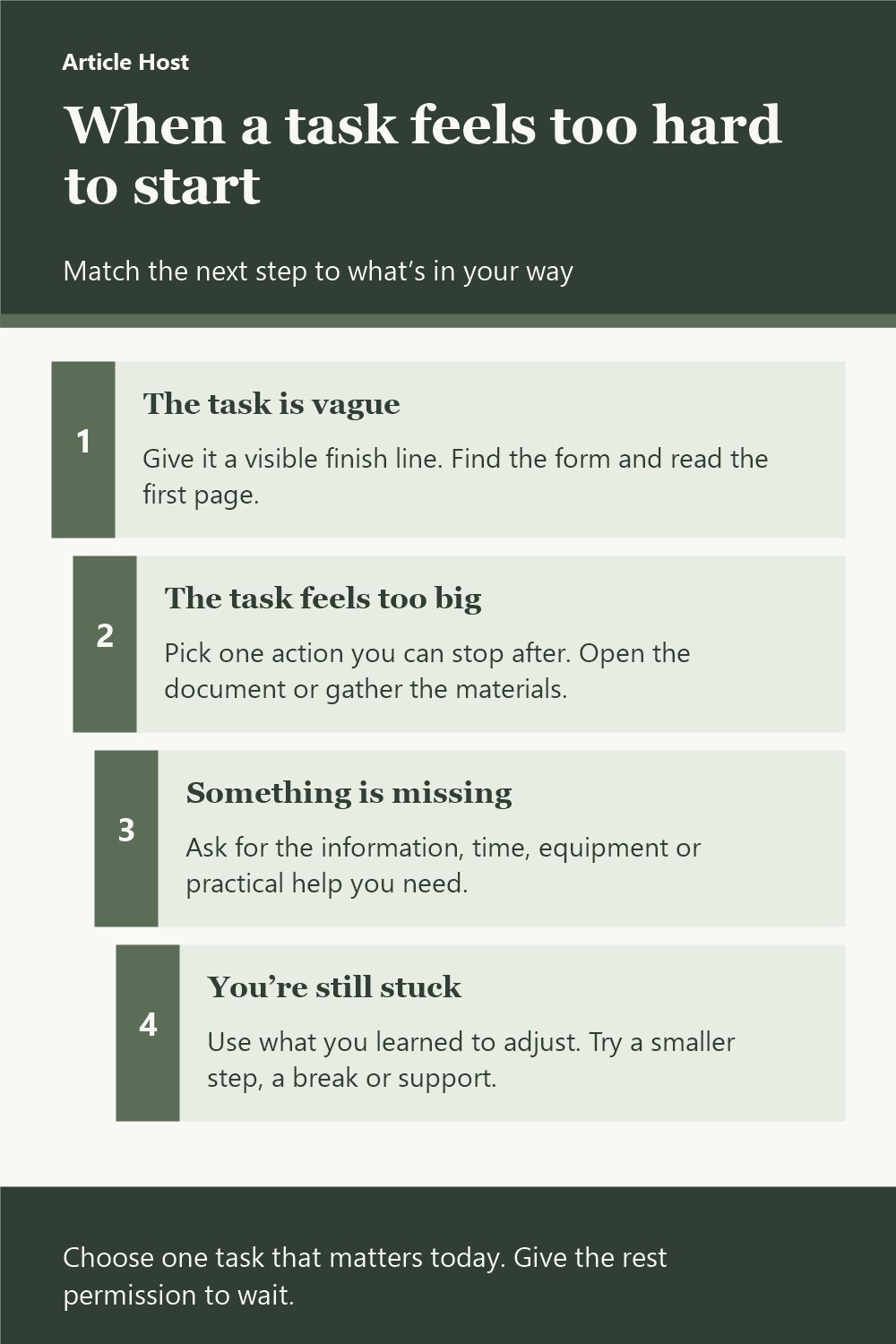
When a task feels too hard to start
- The task is vague Give it a visible finish line. Find the form and read the first page.
- The task feels too big Pick one action you can stop after. Open the document or gather the materials.
- Something is missing Ask for the information, time, equipment or practical help you need.
- You’re still stuck Use what you learned to adjust. Try a smaller step, a break or support.
Choose one task that matters today. Give the rest permission to wait.
Ask what is making the task difficult
Is the instruction unclear? Are you missing information, equipment, time, money or a quiet place? Are competing demands leaving very little room? A practical barrier needs a practical response.
You might need clarification, a different method, an accessible format, a changed deadline or someone to share the task. Looking only for a lack of willpower can miss those needs.
The NHS guide to tackling a to-do list offers general ideas for making activities more manageable and balancing different kinds of tasks. Adapt any suggestion to your circumstances.
Make the starting point small enough to try
Choose an action you can reasonably attempt now. You might open the document, write one question, gather the materials or send a request for information.
If a short time limit helps, decide when you will pause and check how you feel. Continuing is an option, but a small start does not oblige you to keep going past a limit you need.
Reduce unnecessary steps where possible. Keep a useful item nearby, close an unrelated task or write down the next action so you do not need to reconstruct the whole plan later.
You do not need to buy a reward or make food something you must earn. A break, a preferred activity or simply acknowledging the completed step can be part of your plan.

Ask for support that fits the obstacle
Be specific about what would help. “Could you explain the first step?” “Can we review which deadline matters most?” or “Would you sit with me while I begin?” may make the request easier to answer.
Choose someone who can respond respectfully. You do not need a person to be relentlessly positive; practical information, patient company or help with another responsibility may be more useful.
If you are feeling discouraged about the wider situation, our guide to finding hope and practical support offers another way to think about the next step.
Use what happens to adjust the plan
After trying, ask what helped and what remained difficult. A task that is still too large may need another division. An unclear request may need clarification. You may also need rest or assistance.
Ongoing low motivation, changes in sleep or persistent exhaustion can deserve attention beyond a planning exercise. If they affect daily life or concern you, consider speaking with a qualified health professional.
There is no need to restrict sleep, force exercise or stay cheerful to prove that you are trying. A useful plan responds to what you learn and gives you a realistic place to begin again.