

When life feels crowded, “manage your time better” can sound like one more task. Planning can help you see what needs attention, but it cannot create unlimited energy, childcare, money or hours. A more workable day starts with the demands you actually face.
Choose a small change that reduces friction or makes an important task easier to begin. You do not need a perfect routine, a long list or a completely stress-free life to make that change worthwhile.
On this page
Notice where the pressure comes from
Look at a recent ordinary day. What took time? Include paid work, travel, caring for someone, arranging appointments and the small jobs that keep a household going. Rest and recovery also belong in this picture.
Notice the difference between a task you can reorganise and a demand you cannot reasonably meet alone. An overfull workload may need a conversation about priorities. Repeated caregiving interruptions may call for shared responsibility. Neither problem is solved simply by making a more detailed calendar.
You can start with a brief note rather than tracking every minute. The purpose is to understand the pressure well enough to choose a useful response.
Choose a manageable daily list
Write down what is on your mind, then select a short working list. One possible structure is:
- One necessary task with a real deadline or immediate consequence.
- One useful task, if there is room for it.
- Other tasks on a separate list to revisit later.
Check whether the necessary task is realistic today. If it is too large, choose a smaller part or ask the relevant person which piece matters first. Make deadlines visible without treating every preference as an emergency.
Leave room for eating, breaks and transitions. A list that assumes continuous concentration can be difficult to use in a day with meetings, children or fluctuating energy.

Give one task a clear starting point
“Sort everything out” is hard to begin. “Open the appointment letter and check the date” is a clear action. “Prepare a report” might begin with finding the requested figures or writing three questions the report must answer.
Choose a stopping point too: one drawer, one form or one section. If useful, put the materials somewhere accessible so you do not have to search for them next time. An audio reminder or a simple paper note may suit you better than an elaborate app.
You can group similar jobs when that is convenient. Check messages at suitable times, while keeping any work, caring or accessibility arrangements that require you to stay reachable.
Plan for interruptions and support
Before you leave a task, write the next action in a few words. That can give you a place to return to after an interruption. If the task keeps being displaced, reconsider its timing, size or priority.
Ask for help in specific terms when someone is available: “Could you handle dinner while I finish this form?” In a workplace, you might ask which deadline should move when a new urgent task arrives. A clear request gives the other person something concrete to consider.
Some demands cannot be negotiated easily. Recognising that limit can help you focus on available support rather than treating exhaustion as a personal failure.
Review the plan without judging yourself
At the end of the day or week, ask what helped, what got in the way and what could be made smaller. An unfinished list is information about the plan and your circumstances; it is not a measure of your worth.
Keep one useful adjustment. Perhaps placing a reminder beside your keys helped, while an early-morning work session left you too tired. Change the part that did not fit rather than insisting on the routine.
A better day may contain the same responsibilities with a clearer first step, a realistic limit or more help. Give the plan room to change as your life does.
Start with three priorities and a clear restart point
Imagine you have a meeting, an appointment to book and an overdue household task. Confirm the meeting time, jot down the number or form you’ll use for the appointment, and look for a realistic slot for the household task.
If someone needs you unexpectedly, use the written first step to pick up where you left off. If the same task keeps rolling forward, ask what information, time or practical help would let you begin.
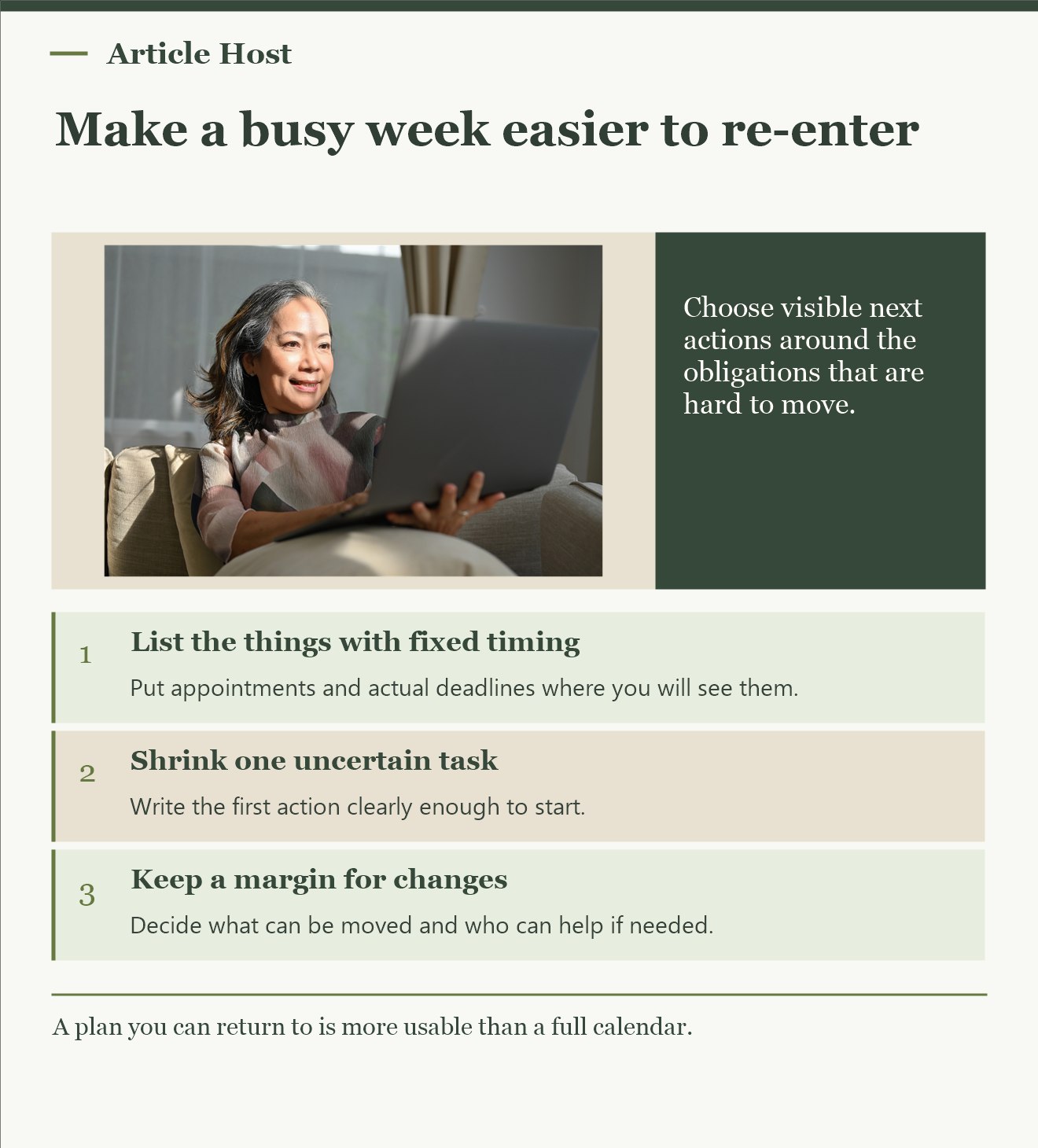
Read the infographic in text
Make a busy week easier to re-enter
Choose visible next actions around the obligations that are hard to move.
- List the things with fixed timing Put appointments and actual deadlines where you will see them.
- Shrink one uncertain task Write the first action clearly enough to start.
- Keep a margin for changes Decide what can be moved and who can help if needed.
A plan you can return to is more usable than a full calendar.